Deep Autumn or Soft Autumn? How to Tell Them Apart
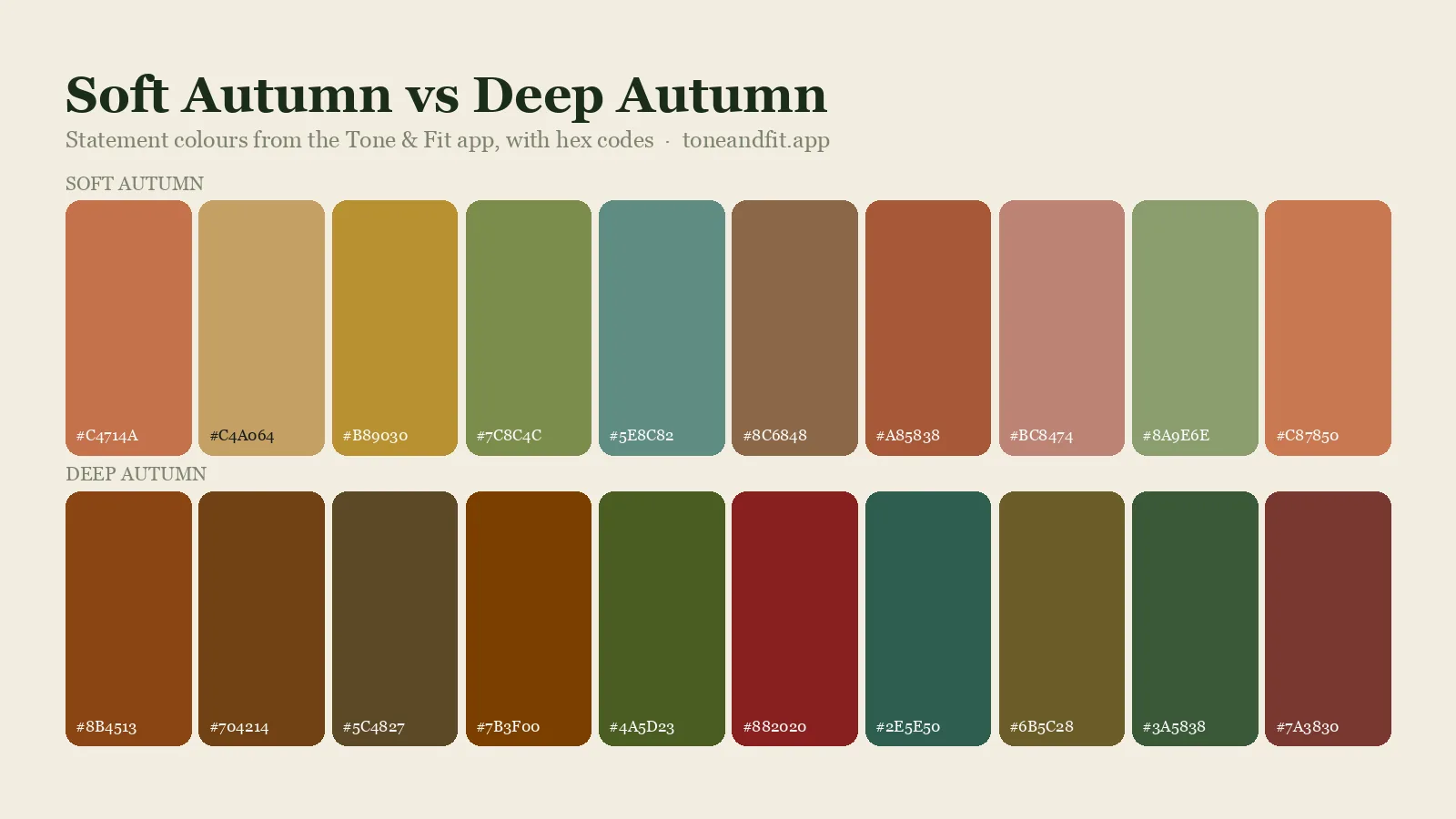
Short answer: Deep Autumn and Soft Autumn share a warm undertone, but they sit at opposite ends of the Autumn family. Deep Autumn is dark, rich and higher in contrast, so it wears espresso, dark teal and aubergine. Soft Autumn is gentle, muted and low in contrast, so it wears dusty olive, soft terracotta and warm taupe. The five tests below settle which one you are.
If you keep landing between these two, you are not doing anything wrong. They agree on warmth and disagree on two measurements that are very hard to judge by eye, and once you know where to look the confusion usually clears up fast.
What's in this guide
Why these two get confused
Deep Autumn and Soft Autumn are two of the three Autumn sub-seasons in the modern 12-season system, alongside Warm Autumn. All three have a warm undertone, which means the colors that flatter them lean golden rather than blue or pink. All three also live in the earthy, roasted half of the color world, where rust, olive, mustard and brown beat icy pastels and neon brights every time.
That shared foundation is why a quiz or a quick glance in the mirror can send you back and forth. If you have read our guides on whether you are a Deep Autumn and whether you are a Soft Autumn and thought both described you, that is a normal result. Warm undertone plus "not bright" describes both seasons accurately. What the surface read misses is how dark and how soft your coloring actually is.
If the vocabulary here is new, our explainer on seasonal color analysis covers undertone, value and chroma from scratch. For the full grid showing where every sub-season sits, see the 12 color seasons.
The two axes that separate them
Every season is a combination of three measurements: undertone (warm or cool), value (light or deep) and chroma (bright or muted). Deep Autumn and Soft Autumn match on undertone. They split on the other two.
Value: how dark is your coloring?
Value is the lightness or darkness of your overall coloring: hair, skin and eyes taken together. Deep Autumn is the darkest of the Autumns. Its coloring has real depth, with dark hair and eyes that stay clearly darker than the skin. Soft Autumn sits in a lighter, middle range, where hair, skin and eyes are closer together in depth and nothing jumps out sharply.
Chroma: how muted is your coloring?
Chroma is how saturated or grayed-down your coloring is. Soft Autumn is the most muted of the Autumns. Its colors carry a touch of gray, so they look dusty, smoky and blended. Deep Autumn is also muted compared with a Spring or Winter, but it is far richer and more saturated than Soft Autumn, which is why it can carry the deep, pigmented shades that would overwhelm a Soft Autumn face.
Put simply: Deep Autumn is defined by depth, and Soft Autumn is defined by softness. A related measurement, contrast, ties the two together. Deep Autumn runs medium to high contrast. Soft Autumn runs low. If you want to measure that yourself, our guide to finding your contrast level walks through it step by step.
Deep Autumn: espresso, dark teal, aubergine, deep chestnut, forest.
Soft Autumn: sage olive, soft terracotta, dusty moss, warm taupe, muted clay.
Deep Autumn vs Soft Autumn side by side
| Soft Autumn | Deep Autumn | |
|---|---|---|
| Undertone | Warm, softened by a touch of neutral | Warm, tempered by depth |
| Defining trait | Muted, soft chroma | Depth, dark value |
| Value | Light to medium | Deep, the darkest Autumn |
| Contrast | Low, blended | Medium to high |
| Saturation | Dusty, grayed-down | Rich, pigmented |
| Signature colors | Sage, soft terracotta, warm taupe, muted peach | Espresso, dark teal, aubergine, deep olive, brick |
| Dark neutrals | Soft brown, charcoal, never harsh black | Espresso, forest, near-black in small doses |
| Best metal | Soft gold, brushed brass, rose gold | Antique gold, bronze, copper |
5 tests to settle it
You cannot tell these seasons apart from a description alone. Sit by a window in indirect daylight, remove makeup, pull your hair back, and hold fabric or paper close to your face. Run all five tests and count which season wins more rounds.
1. The depth test
Hold a rich espresso or dark chocolate brown under your chin, then swap it for a soft taupe or dusty olive. On a Deep Autumn, the dark shade makes the eyes and features look defined and the face look clear. On a Soft Autumn, the same dark shade tends to sit on top of the face like a heavy frame, while the taupe lets everything look harmonious.
2. The grayscale test
Take a well-lit photo and convert it to black and white. A Deep Autumn shows clear separation: dark hair and eyes against lighter skin. A Soft Autumn shows a gentle, blended image where hair, skin and eyes sit close together in tone with no dramatic jumps.
3. The dusty versus rich test
Compare a dusty sage green with a saturated forest green, or a powdery clay with a deep brick red. If the dusty versions make your skin look smooth and even, you lean Soft Autumn. If they look faded and the rich versions make you glow, you lean Deep Autumn.
4. The black test
Drape a true black near your face, then a deep warm brown. Deep Autumn can sometimes carry a soft black in small doses, although espresso is still kinder. Soft Autumn almost always looks drained in black, because the harsh edge overpowers a low-contrast face. Charcoal brown or soft dark olive is far better.
5. The brightness test
Hold a clear, bright color like a vivid coral or a clean emerald next to your face. Both Autumns will find it too loud. If you look tired but still strong, you probably have depth to spare and lean Deep Autumn. If you look washed out or simply overpowered by the color, you lean Soft Autumn.
If your tests keep pointing in different directions, go back a step and confirm the basics by finding your skin undertone at home, and read our guide to warm versus cool undertones. Both of these seasons are warm, so a cool result means you may belong to a different family altogether.
Stop guessing which Autumn you are.
Tone & Fit's AI measures your undertone, value and chroma from a selfie and tells you whether you are Deep Autumn, Soft Autumn or something else, with your full palette in 60 seconds.
Try the App ↗How the palettes differ
The wardrobe payoff of getting this right is real. The two palettes overlap in the middle and part ways at the extremes.
Where they overlap
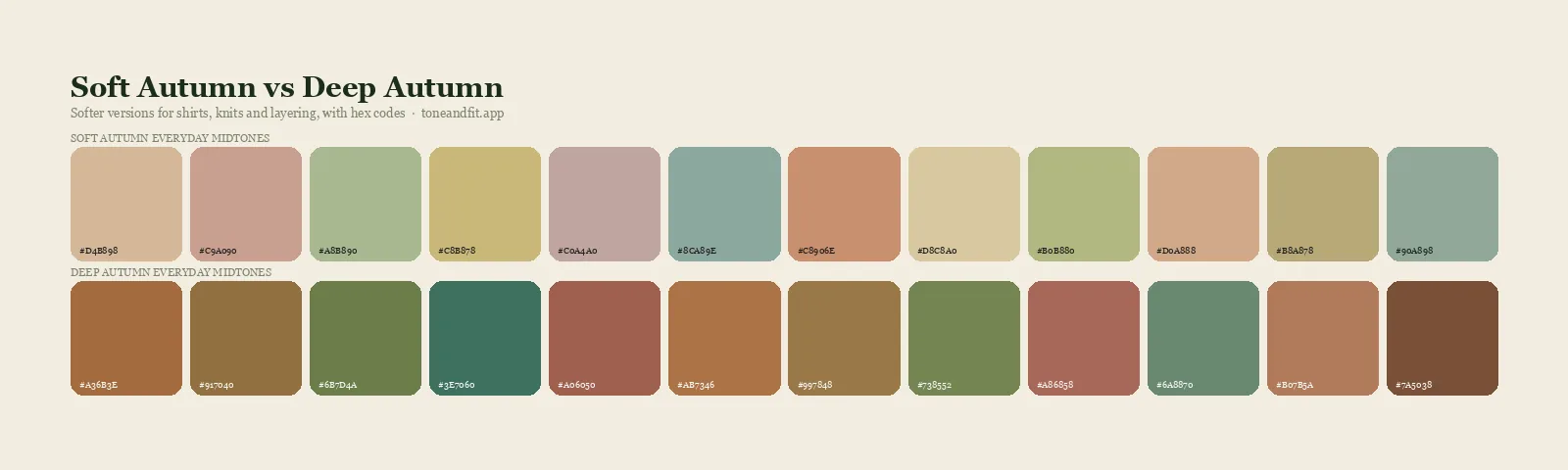
Warm olive, terracotta, camel, rust-leaning browns and muted golds work on both seasons, as long as they are pitched at the right intensity. A mid-tone olive sweater can work on either. The difference is the finishing touch: a Soft Autumn wears it dusty and a Deep Autumn wears it dark.
Where Soft Autumn pulls ahead
Soft Autumn owns the powdery, gentle end: sage, muted peach, warm stone, soft khaki, dusty rose-brown and oatmeal. These colors need low contrast and a gentle surface to look right. On a Deep Autumn they can read as flat and washed out. The full list with hex codes is on the Soft Autumn color palette page, and our Soft Autumn outfit ideas show how to put them together.
Where Deep Autumn pulls ahead
Deep Autumn owns the dark and saturated end: espresso, dark chocolate, deep forest, dark teal, aubergine, burnt sienna and deep brick. These colors need real depth in the wearer. On a Soft Autumn they tend to overwhelm the face. See the Deep Autumn color palette for every shade, and Deep Autumn outfit ideas for how to wear them. If you want a ready-made wardrobe plan, try the Deep Autumn capsule wardrobe or the Soft Autumn capsule wardrobe.
The wider Autumn family is shown together on the full Autumn palette page, which is a good way to see all three sub-seasons in one place.
Hair, makeup and metals
The same value and chroma split shows up in everything you put near your face.
Hair. Deep Autumn suits rich chocolate, dark chestnut and deep auburn with warm, glossy depth. Soft Autumn suits softer, blended shades such as light chestnut, warm honey-brown and gentle caramel, and tends to look better with fewer harsh contrasts between roots and ends. Our guides to Deep Autumn hair color and Soft Autumn hair color go through both.
Makeup. Deep Autumn can wear deep brick, dark terracotta and wine lips, and bronzed, defined eyes. Soft Autumn does better with muted rose-brown, soft peach and blended, smoky-but-gentle eyes. See the Deep Autumn makeup guide and the Soft Autumn makeup guide for specific shades.
Metals. Both seasons are warm, so gold beats silver for both. Deep Autumn handles bold antique gold, bronze and copper. Soft Autumn prefers brushed, softer finishes such as matte gold, brass and rose gold.
Menswear follows the same logic. If you are shopping for a partner or yourself, see Deep Autumn colors for men and Soft Autumn colors for men.
Common mistakes and look-alikes
Assuming dark hair means Deep Autumn. Hair alone does not decide it. A Soft Autumn can have dark brown hair, and the overall softness of the skin and eyes is what pulls the season toward muted. Read the whole face, not a single feature.
Assuming light hair means Soft Autumn. A Deep Autumn can have dyed or sun-lightened hair and still be clearly deep in the skin and eyes. If your hair has been colored for years, our guide on finding your color season with dyed hair shows how to read through it.
Confusing Soft Autumn with Soft Summer. These two both look muted and gentle. The split is undertone: Soft Autumn is warm and Soft Summer is cool. Our comparison of Soft Autumn vs Soft Summer covers it in detail.
Confusing Deep Autumn with Deep Winter. Both are dark, but Deep Autumn is warm and muted while Deep Winter is cool and clear. See Deep Autumn vs Deep Winter if espresso suits you but warm rust still feels slightly off.
Mixing up Deep Autumn and Warm Autumn. That is the third pairing in the Autumn family, and it comes down to depth versus pure warmth. Our guide to Deep Autumn vs Warm Autumn has the details.
Wearing your closest wrong palette. If you are a Soft Autumn who has been wearing deep, dark colors, you may feel heavy and tired without knowing why. Our list of Soft Autumn colors to avoid and Deep Autumn colors to avoid can help you spot what is working against you.
The honest truth is that this is a genuinely fine distinction, and judging value and chroma from a mirror is hard for anyone. When the tests split, measuring directly is the fastest route to a confident answer. If you are weighing your options, our guide to personal color analysis covers the DIY, app and professional routes, and you can also take the free color analysis quiz as a first pass.
Ready to find your season?
One selfie, your 12-season result, and the palette that goes with it. Free, no sign-up.
Find your season free ↗FAQ
What is the main difference between Deep Autumn and Soft Autumn?
Depth versus softness. Deep Autumn is defined by darkness: rich, saturated, shadowed colors like espresso, dark teal and aubergine. Soft Autumn is defined by muted, low-contrast blending: dusty olive, soft terracotta and warm taupe. Both are warm, but they sit at opposite ends of the Autumn family.
Is Soft Autumn lighter than Deep Autumn?
Usually yes. Soft Autumn sits in a light-to-medium range with gentle contrast, while Deep Autumn is the darkest of the three Autumns with medium to high contrast. Lightness is not the defining trait of Soft Autumn though. Muted, grayed-down color is.
Can a Deep Autumn wear Soft Autumn colors?
Some of them. Warm earthy mid-tones like olive and terracotta cross over, but the dusty, powdery shades of Soft Autumn can look faded on a Deep Autumn. Deep Autumn looks best when those hues are pushed darker and richer.
Why do I keep getting both Deep Autumn and Soft Autumn?
Because they share a warm undertone and a lack of brightness. The split comes from value and chroma, which are the two measurements that are hardest to judge by eye in a mirror. If results flip between them, test contrast and saturation directly.
Which is better for dark brown hair, Deep Autumn or Soft Autumn?
Dark brown hair does not decide it. A Deep Autumn has dark hair with clear contrast against skin and eyes. A Soft Autumn can also have brown hair, but it tends to be an ashy or mid-depth brown that blends with the skin rather than standing apart from it.
How do I confirm my Autumn sub-season?
Run a depth test and a saturation test in daylight, then confirm with a measurement. An AI color analysis from a selfie measures undertone, value and chroma directly, which is more reliable than judging a subtle difference by eye.