Warm Spring or True Spring? How to Tell Which Spring Season You Are
You already know you are warm. Gold beats silver, coral beats rose, and cream beats stark white every time. The question left is whether your palette wants pure clear color or the same colors with a spoonful of gold stirred in.
What's in this guide
What the two Spring seasons share
Warm Spring and True Spring are neighbors on the color wheel, and they agree on almost everything. Both are warm. Both are bright. Both belong to the Spring family, which in the modern twelve-season system means light-to-medium value, golden undertone, and enough clarity that dusty colors drain them. Put the two palettes side by side on a screen and most people cannot tell which is which.
Both seasons light up next to yellow gold, brass, and warm rose gold, and both go slightly flat next to cool polished silver. Both prefer coral and peach over blue-pink, tomato-red over cherry-red, and ivory or cream over optical white. If you have run the vein check, the jewelry check, and the white-versus-cream drape from our guide to finding your skin undertone at home, both seasons would give you the same answer at every step: warm, warm, warm. Our gold or silver jewelry test would also point both of you to gold without hesitation.
That shared warmth is exactly why undertone alone cannot separate them. Undertone is only one of three measurements. As our primer on seasonal color analysis explains, every season is a combination of undertone (warm or cool), value (light or deep), and chroma (bright or muted). These two agree on undertone, sit close on value, and part ways on a subtler axis: which of their two traits is dominant.
If you already suspect one of the two, our dedicated guides on whether you are a Warm Spring and whether you are a True Spring go deep on each season on its own. This article is for the moment you have read both and still feel caught in the middle.
The one difference that matters
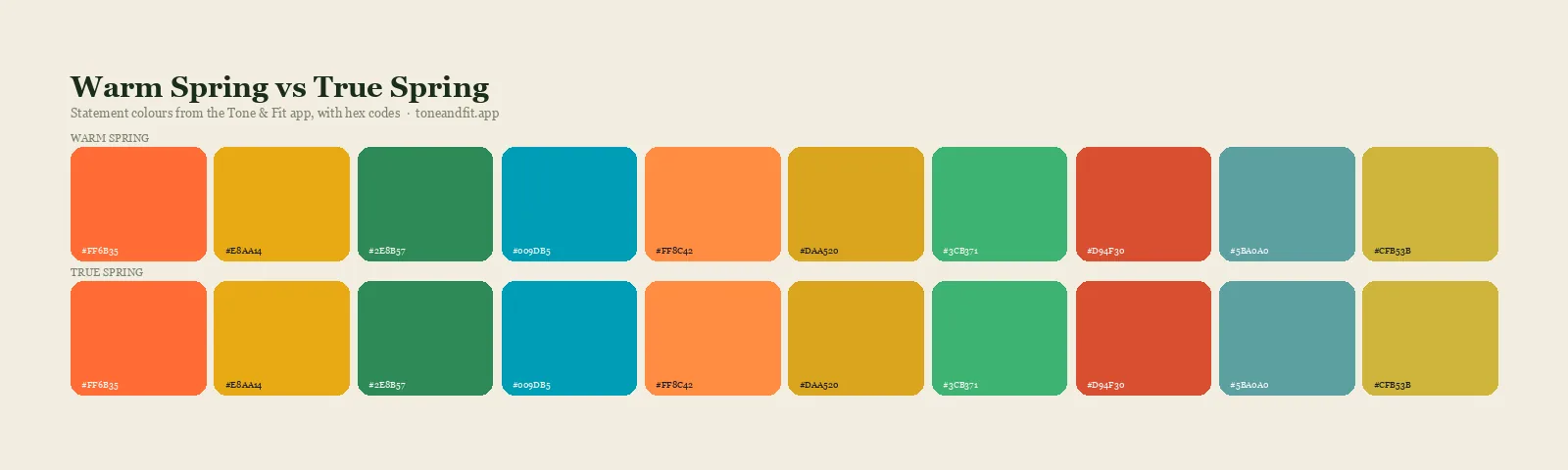
Here is the whole distinction in two sentences. True Spring is balanced equally between warm and bright, sitting at the family's peak clarity. Warm Spring leads with warmth, so brightness steps back one notch and the palette drifts a half-step toward gold.
Every season in the twelve-season system has a dominant trait and a secondary one. The "true" seasons are the pure center of each family, where the two traits are balanced. The named-direction seasons lean. True Spring is the balanced center of Spring: it can carry the most saturated, cleanest warm color of any season without being overpowered. Warm Spring lives one step along the warm axis, closer to the border with Autumn, which means its colors keep the golden glow but trade a little of that poster-paint clarity for richness.
The shorthand we use in our own season guides is honey versus lemon. True Springs glow in clear, pure color. Warm Springs glow in slightly richer, more golden versions of the same color. Neither is duller than the other in the sense of being greyed or dusty. Warm Spring is not a muted season. It is a warm-leaning bright season, which is a different thing entirely, and confusing the two is the single most common error people make when self-diagnosing.
So the question that decides between them is not "am I warm?" You already know you are. The question is "does color need to be pure to flatter me, or does it need to be golden?" Everything below is a way of answering that. For the wider context of where these two sit among all twelve seasons, our overview of the 12 color seasons maps the full grid, and our Spring color palette guide covers what the whole family has in common.
Warm Spring vs True Spring side by side
A quick reference before the tests. Notice how the top two rows agree and every difference below them flows from which trait leads.
| True Spring | Warm Spring | |
|---|---|---|
| Undertone | Warm | Warm |
| Family | Spring | Spring |
| Dominant trait | Balanced warm and bright | Warmth leads |
| Chroma | Peak clarity, pure | Bright but one step richer |
| Neighbor season | Light Spring and Bright Spring | Warm Autumn |
| Signature yellow | Clear lemon and daffodil | Honey and golden amber |
| Signature coral | Pure bright coral | Terracotta-coral |
| Blue-green | True turquoise | Warm teal, seafoam |
| Typical hair | Golden blonde to light copper | Honey to golden chestnut |
| Metals | Bright polished gold | Antique or brushed gold, brass |
True Spring vs Warm Spring: the same question from the other end
The comparison reads the same in reverse. True Spring vs Warm Spring is one question asked twice: is your colouring the brighter, clearer version of Spring, or the one where warmth leads and everything sits a little softer and more golden? If clear, saturated brights look alive on you, you are True Spring. If they feel slightly loud next to warm corals and golden greens, you are Warm Spring.
4 tests to settle it
Descriptions only get you so far. Put real color next to your face in indirect daylight, no makeup, hair pulled back, and watch what your skin does rather than what the fabric does. Run all four tests and count which season wins more rounds.
1. The yellow test (the decider)
Yellow is the most honest color in the Spring family because both seasons can wear it, which means the only variable left is which yellow. Hold a clear lemon or daffodil yellow up to your chin, then swap it for a deep honey or golden amber. On a True Spring, the clear yellow makes the skin look fresh and the eyes look lit, while honey can read slightly heavy or aging. On a Warm Spring the reverse happens: honey looks luxurious and warm against the skin, while clear lemon reads a touch acidic and can pull faint green into the face.
2. The coral test
Both seasons own coral, so test the version rather than the family. Hold a pure, bright coral next to a terracotta-coral, the kind with visible brick in it. True Spring skin holds its own against the bright one and looks fresher for it. Warm Spring skin often finds the pure coral slightly loud and settles visibly when the terracotta version comes in, because that extra earth pigment matches the gold already in the skin.
3. The turquoise test
Blue-greens separate these two faster than almost anything, because turquoise is where warmth and clarity pull against each other. Drape a clean, bright true turquoise, then a warm teal or seafoam. A True Spring can wear the clear turquoise without strain and often looks striking in it. A Warm Spring usually needs that same shade warmed and deepened, otherwise the color reads slightly cold and the skin looks a shade duller than it did a second ago.
4. The drift test
Instead of testing the two seasons against each other, test each one against its neighbor and see which direction feels survivable. Try a genuinely muted warm earth tone like olive or rust. On a Warm Spring these look almost right, a little heavy but not wrong, because Warm Spring borders Warm Autumn. On a True Spring the same shades look distinctly dull and dirty, since True Spring sits further from the Autumn border. Whichever way you can drift without disaster tells you where you actually live.
One caution before you score yourself. Make sure the warm premise actually holds. If several drapes keep suggesting coolness, back up and re-run the fundamentals in our explainer on warm versus cool undertones, because a bright cool season under golden indoor light can easily masquerade as a Spring.
Stop guessing which Spring you are.
Tone & Fit's AI measures your undertone, value, and chroma from a single selfie and tells you whether you're True Spring, Warm Spring, or something else entirely, with your full palette in 60 seconds.
Try the App ↗How the palettes diverge
The payoff for getting this right is a wardrobe where every piece flatters and every piece matches every other piece. Both palettes share a golden backbone, but they differ in purity, and knowing which purity is yours changes nearly every purchase you make.
Where they agree
The seasons meet across a wide middle band: golden yellow, warm coral-pink, medium warm green, camel, and cream. These border colors are why a borderline Spring can shop from either palette for years without ever noticing something is slightly off. If you are truly stuck, live in this shared zone while you work it out, because nothing here will actively fight you.
The shared Spring core: golden yellow, warm coral, medium warm green, camel, cream.
Where True Spring pulls ahead
True Spring owns the clean, high-voltage end of warmth: pure coral, warm apricot, clear leaf green, true turquoise, and poppy or pumpkin orange. These are colors with no grey in them at all, and they need the natural clarity True Spring has in order to stay balanced. On anyone softer they start to wear the person instead.
True Spring exclusives: pure coral, warm apricot, clear golden yellow, leaf green, true turquoise.
Where Warm Spring pulls ahead
Warm Spring owns the golden, sun-warmed end: terracotta-coral, warm peach, moss-leaning warm green, warm teal, and copper. Read against a True Spring palette these look like the same colors seen through late afternoon light rather than noon light. On a Warm Spring they look rich and glowing. On a True Spring the same shades can look slightly muddy, as though someone turned the saturation down a step too far. The complete range, including neutrals and how to combine them, is laid out in our Warm Spring color palette guide.
Warm Spring favorites: terracotta-coral, warm peach, golden yellow, warm green, warm teal.
Neutrals follow the same logic. Neither season should reach for black or cool grey near the face, and both do better in ivory, camel, and warm taupe. The difference is the depth: True Spring stays lighter and cleaner with its neutrals, while Warm Spring can carry a deeper camel or a warm chocolate brown that would weigh a True Spring down. If you want to see the difference in real outfits, our Warm Spring outfit ideas show the golden end of this spectrum in practice.
Hair, makeup, and metals
Clothing gets most of the attention, but the two seasons diverge just as clearly in the things that sit closest to your face.
Hair. Neither season suits ash. Both need gold in the tone, and both look wrong the moment a stylist reaches for a cool toner to "neutralize brassiness," because for a Spring that brassiness is the point. The split is depth and contrast. True Spring shines in clear golden blonde, honey, and light copper, usually with bright buttery highlights and visible lift. Warm Spring goes deeper and lower contrast: caramel, warm honey, golden chestnut, and rich copper, with highlights that blend rather than pop. Our guide to the best hair colors for Warm Spring covers the golden end in detail, and the broader best hair color for your skin tone guide places both seasons in the wider map.
Makeup. True Spring can wear a clear coral or bright warm pink lip and look finished rather than costumed. Warm Spring tends to look better one step deeper and warmer: peachy nude, warm terracotta, or a soft brick coral. In blush the same rule applies, with True Spring in clear peach and Warm Spring in warm apricot. For a full routine built around golden Spring coloring, see our Warm Spring makeup guide.
Metals. Gold for both, but the finish differs. True Spring suits bright polished gold with high shine, matching its own clarity. Warm Spring is flattered by antiqued, brushed, or hammered gold and brass, which carry the same richness as its palette. Rose gold works on both, and copper is a Warm Spring signature.
Common mistakes and look-alikes
A few traps catch nearly everyone trying to settle this fork on their own.
Reading "warm" as "muted." This is the big one. Warm Spring is a Spring, which means bright by definition. If dusty, greyed, or genuinely earthy colors flatter you more than golden clear ones, your fork is probably not Warm Spring versus True Spring at all. It is Warm Spring versus Warm Autumn, and that is a different comparison entirely.
Testing under warm indoor light. A golden bulb adds warmth to everything, which nudges a True Spring toward the Warm Spring answer and can make anyone look like a Spring. Test in indirect daylight near a window, and never immediately after being outdoors in strong sun.
Judging by hair color. A True Spring who has gone caramel and a Warm Spring who has gone golden blonde will look like each other's season in photographs. Judge the reaction of your skin to the drape, not the shade currently on your head.
Stopping at the wrong fork. If warmth suits you but everything feels slightly too intense across the board, your real question may be whether you are a Light Spring, where lightness rather than warmth or brightness leads. And if you find that certain shades consistently drain your face no matter which Spring palette they came from, our guide to colors that wash you out explains the four mechanisms behind it.
If you have run all four tests and still feel split, that is not a personal failure. A one-step difference in chroma is genuinely hard to see, and the human eye is notoriously bad at judging saturation on its own face, especially when the two options are as close as these. This is exactly the case where measurement beats intuition. Our comparison of a color analysis app versus a consultant weighs the two routes honestly, and the full personal color analysis guide ties the whole system together if you want the complete picture before deciding. Seeing the seasons on faces also helps, which is why our roundup of Warm Spring celebrities is worth a look once you have a working theory.
Ready to find your season?
One selfie, your 12-season result, and the palette that goes with it. Free, no sign-up.
Find your season free ↗For the underlying reading, analyze your skin tone explains what undertone, depth and contrast actually are.
FAQ
What is the main difference between Warm Spring and True Spring?
Which trait leads. True Spring is balanced equally between warm and bright and sits at peak clarity. Warm Spring is warm-dominant, so warmth leads and brightness steps back one notch. The easiest shorthand is honey versus lemon: True Springs glow in clear pure colors, Warm Springs glow in slightly richer, more golden versions of the same colors.
Does Warm Spring mean muted?
No, and this is the most common misreading. Warm Spring is softer than True Spring but still clearly a Spring, which means it is still bright compared with any Autumn season. Warm Spring colors are golden and rich rather than dusty or greyed. If genuinely muted earth tones look better on you than golden clear ones, you are more likely a Warm Autumn than a Warm Spring.
Do Warm Spring and True Spring share any colors?
Yes, a wide band of them. Golden yellow, warm coral, camel, cream, and warm medium greens sit close enough to the line that both seasons wear them well. The seasons split at the extremes: pure poster-bright coral and true turquoise belong to True Spring, while copper, terracotta, and warm teal belong to Warm Spring.
Which Spring season can wear turquoise?
Both, but at different temperatures. True Spring carries a clean, bright true turquoise without strain because it can balance high chroma. Warm Spring usually needs that same shade warmed and deepened toward seafoam or warm teal, otherwise the color reads slightly cold against golden skin and the face loses a little light.
What hair color suits Warm Spring versus True Spring?
Both need warm, golden tones and neither suits ash. True Spring looks best in clear golden blonde, honey, and light copper with bright, buttery highlights. Warm Spring leans deeper and richer: caramel, warm honey, golden chestnut, and copper, with less contrast between base and highlights.
How can I be sure which Spring season I am?
Run the yellow test, the coral test, the turquoise test, and the drift test together in indirect daylight. If three point the same way, trust that answer. If they split, an AI color analysis or a professional drape measures your chroma and warmth directly instead of asking your eye to judge a one-step difference on your own face.