Best Swimsuit Colors for Your Skin Tone

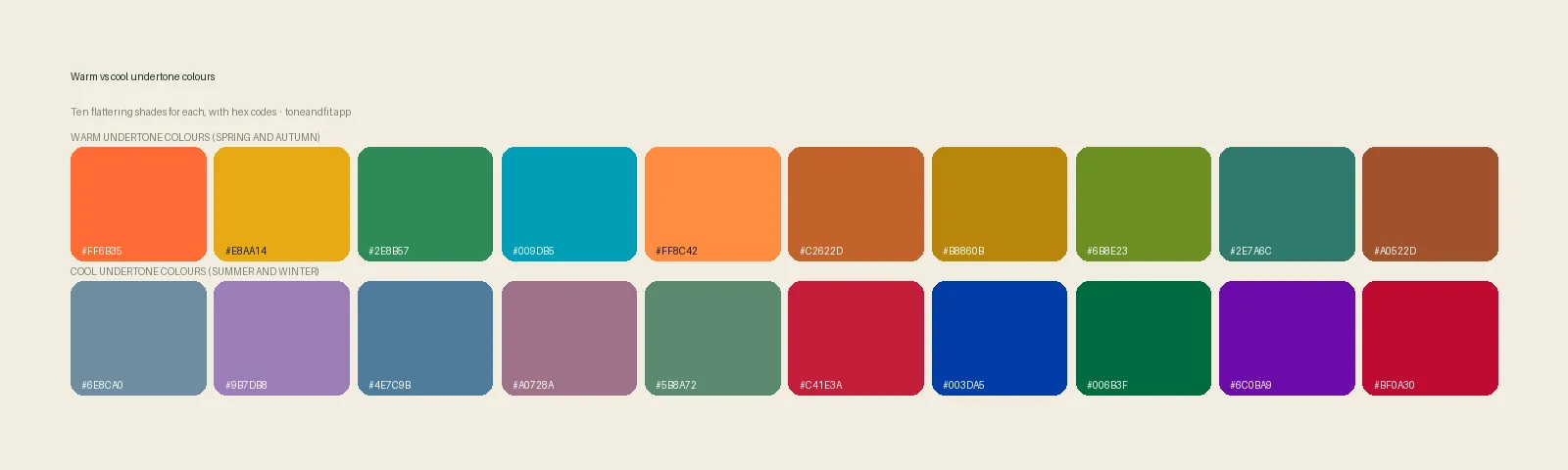
The best swimsuit color matches your undertone's temperature. Warm skin looks lit-from-within in coral, warm red, gold-flecked prints, and olive green. Cool skin looks its brightest in true red, cobalt, emerald, and black-based prints. Get the temperature right and the same cut that looked flat under dressing-room lighting looks completely different on the beach.
What's in this guide
- Why swimsuit color is the highest-stakes color decision you'll make
- Step 1: Find your undertone first
- Best swimsuit colors by undertone
- Best swimsuit colors by season
- Best swimsuit colors for your specific skin tone
- One-pieces, bikinis, and prints: how the rules change
- Common swimsuit color mistakes
- FAQ
Why swimsuit color is the highest-stakes color decision you'll make
A swimsuit exposes more bare skin than almost anything else you wear, and it does so under the least forgiving light there is: direct sun, water reflections, and none of the makeup or styling that usually softens a color's edges. There is no shirt collar, no scarf, no jacket lapel to buffer the color from your face and chest. The fabric sits directly against your skin, and whatever temperature it carries, warm or cool, gets cast right back onto you.
That's why the same navigation that decides your best hair color or your best lipstick shade applies here with even less room for error. If you already know your undertone from a skin tone analyzer reading or a full color season analysis, you can skip straight to the chart below. If you don't, the next section takes two minutes.
The upside of getting this right is real: a swimsuit in your own temperature makes a plain tan look sun-warmed instead of blotchy, keeps pale skin looking clear instead of washed out, and photographs well in exactly the harsh, high-contrast light that beach and pool photos are shot in.
Step 1: Find your undertone first
Before you can shop with any confidence, you need to know one thing: are you warm, cool, or neutral? This is a different question from how light or dark your skin is. Two people with the exact same depth of tan can have opposite undertones and need opposite swimsuit colors.
- Warm undertone: your skin has a golden, peachy, or yellow cast. Gold jewelry sits better against your skin than silver does. Warm swimsuit colors, coral, papaya orange, warm red, gold, and olive, will harmonize with your skin instead of fighting it.
- Cool undertone: your skin has a pink, red, or blue cast. Silver flatters you more than gold. Cool swimsuit colors, true red, cobalt, emerald, fuchsia, and black, will harmonize with your skin.
- Neutral undertone: a balanced mix of both. You have the widest range, but you'll still look best staying in the muted middle of either chart rather than at its extremes.
For the full walkthrough, read our guide to finding your skin undertone at home, or the deeper breakdown of warm vs cool skin undertone. Once you know your undertone, pairing it with your value (how light or deep you read overall) and your chroma (how muted or vivid your coloring is) gives you one of the 12 color seasons, which is the fastest shortcut to a flattering swimsuit shade.
Best swimsuit colors by undertone
Screenshot whichever row is yours before you start scrolling a swimwear site. This alone will cut a hundred options down to a dozen worth trying on.
| Undertone | Best swimsuit colors | Use caution |
|---|---|---|
| Warm | Coral, papaya orange, warm tomato red, gold, mustard, olive green, warm turquoise | Icy pastels, cool fuchsia, silver metallics, blue-black |
| Cool | True red (blue-based), cobalt, royal blue, emerald, fuchsia, black, icy white | Orange-red, mustard, warm coral, gold metallics |
| Neutral | Watermelon pink, teal, soft black, muted jewel tones | Very saturated warm or very icy cool extremes |
Best swimsuit colors by season
Your undertone tells you the temperature. Your full color season adds how light, deep, muted, or bright your coloring is, which narrows things further. Here's what tends to work best for each of the four season families.
Spring (warm + light/bright)
| Best swimsuit colors | Why they work |
|---|---|
| Coral | Mirrors Spring's natural warmth and keeps the whole look bright |
| Tangerine | A saturated warm shade that matches Spring's clarity |
| Buttercup yellow | Reads as sunny rather than washed out on warm, light skin |
| Warm turquoise | Adds contrast without introducing any cool grey |
Avoid: pure black (too heavy for Spring's light value), icy pastels, cool grey.
Likely seasons: Warm Spring, Light Spring, Bright Spring.
Summer (cool + light/soft)
| Best swimsuit colors | Why they work |
|---|---|
| Dusty rose | A soft cool pink that matches Summer's gentle, muted quality |
| Soft periwinkle | Cool without being harsh, echoes Summer's low contrast |
| Seafoam | A muted cool green that reads as fresh rather than loud |
| Muted denim blue | Keeps the cool temperature while staying soft |
Avoid: neon orange, mustard, hot coral, anything with a warm, saturated cast.
Likely seasons: Light Summer, Cool Summer, Soft Summer.
Autumn (warm + deep/rich)
| Best swimsuit colors | Why they work |
|---|---|
| Rust | Autumn's signature warm, earthy red |
| Olive | Deep and warm, matches Autumn's richness |
| Warm terracotta | A sun-baked warm tone that never looks icy |
| Deep mustard | Adds richness while staying firmly warm |
Avoid: icy pastels, cool fuchsia, silver, anything with a blue undertone.
Likely seasons: Warm Autumn, Soft Autumn, Deep Autumn.
Winter (cool + deep/bright)
| Best swimsuit colors | Why they work |
|---|---|
| True red | A blue-based red that matches Winter's clarity and drama |
| Black | Winter's natural high contrast makes classic black look intentional, not flat |
| Cobalt | Bold and cool, matches Winter's saturation |
| Emerald or fuchsia | Jewel tones that hold up against Winter's deep, high-contrast coloring |
Avoid: warm coral, mustard, muted earth tones that flatten Winter's natural contrast.
Likely seasons: Cool Winter, True Winter, Deep Winter.
Find your season before you shop for swim
One selfie, your undertone and season in 60 seconds, free.
Try Tone & Fit free ↗Best swimsuit colors for your specific skin tone
Season is the most reliable roadmap, but people often search by skin tone directly. Here's how it maps in practice.
Fair skin, warm undertone
You likely have a peachy or golden-ivory complexion that burns before it tans. Coral and warm pink sit close to your own coloring without overwhelming it, and a warm turquoise adds contrast without going cool. Very deep, saturated colors can look heavy against fair, light coloring, so save those for a few shades lighter than you'd expect.
Fair skin, cool undertone
Porcelain or pinkish skin looks clearest in soft, cool shades: dusty rose, periwinkle, seafoam. These read as fresh rather than harsh. Where fair cool skin runs into trouble is warm, saturated shades like hot coral or mustard, which tend to make the pink in the skin look ruddy rather than rosy.
Olive skin
Olive is one of the most commonly misread skin tones, since its greenish-yellow cast can look warm at a glance while actually leaning cool underneath, or the reverse. If you're a warm olive (often Autumn), rust, olive, and warm terracotta are safe bets. If you're a cool olive (often Winter or Summer), emerald and cool jewel tones do more for you than anything orange-based. Read our full breakdown of the best colors for olive skin tone if you're not sure which side you're on.
Tan or medium skin
A tan changes how deep your skin reads, but it does not change your undertone underneath it. Medium warm skin can wear the full Spring or Autumn range with confidence. Medium cool skin looks best avoiding orange-based colors even at a deep tan, since the clash is about temperature, not depth.
Deep skin
Deep skin, warm or cool, has the most range of any group because the contrast between a bold color and deep skin naturally reads as striking rather than jarring. Warm deep skin looks rich in warm red, gold, and olive. Cool deep skin looks striking in true red, emerald, and black. For more detail, see our guides to best colors for dark skin tones and color analysis for deep skin tones.
Very pale skin
If you burn easily and read as very pale, softer, lighter versions of your temperature's palette usually work better than the most saturated version of a color. See our dedicated guide to best colors for pale skin for the full breakdown, including which neutrals to pack for cover-ups.
One-pieces, bikinis, and prints: how the rules change
A solid one-piece is the biggest single canvas you'll wear all summer, which is exactly why undertone matters most there. If you only follow this guide for one purchase, make it that one.
Bikini separates give you two smaller canvases instead of one, which makes bold, saturated colors more forgiving; a loud coral top reads differently across a whole one-piece than it does across a triangle top. The one rule that still holds: keep the top and bottom in the same temperature family. A warm coral top paired with a cool fuchsia bottom creates a visible clash right at your midsection, the exact spot most photos are framed around.
Prints are judged the same way as solids, just look at the print's dominant background color rather than every color in it. A tropical print with a coral base will read warm even if it has a few cool accent leaves; a print with a navy or black base will read cool. Hold the fabric near your face (or your phone camera, since phone cameras distort color more than people expect) and judge the overall cast, not each individual thread.
Black deserves its own note, because "black is safe" is one of the most common swimsuit myths. There are two versions: a cool, blue-black, and a warm, brown-black or bronze-black. Cool undertones do best in true blue-black. Warm undertones look better in a warm black or a very deep chocolate brown that reads as black from a distance but doesn't fight a golden undertone up close.
If you're packing more than one suit for a trip, think of it the way you'd think about a capsule wardrobe by color season: pick two or three pieces in your own temperature that can mix and match with cover-ups, rather than one suit per color of the rainbow.
Common swimsuit color mistakes
- Buying the trend color regardless of undertone. Every summer has an "it" shade. It looks incredible on some people and flat on others, and the difference is entirely about temperature, not taste.
- Assuming a tan changes your undertone. It doesn't. A tan changes your value (how deep your skin reads); your undertone, the warm or cool cast underneath, stays exactly the same all season. See how lighting and tanning affect color perception without actually changing your season.
- Trusting a dressing-room mirror over daylight. Fitting-room lighting is famously unflattering and often color-shifted. If you can, step outside or near a window before deciding.
- Matching the swimsuit to the cover-up print instead of to your skin. A cute matching set only works if the print's dominant color already suits you; otherwise you've just doubled down on the wrong color.
Know your undertone before your next trip
Snap a selfie and get your color season free, no sign-up required.
Find your season free ↗FAQ
What's the best swimsuit color for pale skin?
It depends on whether your pale skin is warm or cool. Pale warm skin (often Light Spring) looks best in coral, warm pink, and turquoise. Pale cool skin (often Light Summer) looks best in soft periwinkle, dusty rose, and seafoam. Both should be cautious with very deep or very saturated colors, which can overwhelm lighter coloring rather than flatter it.
Can I wear black if I have a warm undertone?
Yes, but look for a warm black, one with a brown or bronze base rather than a true blue-black. Pure jet black with a cool, blue cast can make warm skin look sallow next to it. A soft black or a near-black chocolate brown reads as warm-friendly while still giving you that classic, slimming effect.
Does a tan change what color swimsuit suits me?
No. A tan deepens your skin's value, how light or dark it reads, but it does not change your undertone, which is the temperature underneath the surface color. A cool-undertone person is still cool-undertone after a week at the beach; they may simply be able to wear slightly deeper versions of their cool palette.
What swimsuit color is the most universally flattering?
There is no single color that flatters everyone, because flattery is about matching temperature, not picking a universally safe shade. That said, a well-chosen red exists in both a warm, orange-based version and a cool, blue-based version, which is why red so often gets called universal: almost everyone can find a red in their own temperature.
Should my bikini top and bottom be the same color?
They do not have to match exactly, but they should stay in the same temperature family. Pairing a warm coral top with a cool fuchsia bottom creates a visible clash right at your midsection. Two different warm colors, or two different cool colors, will always look more intentional than mixing temperatures.
What swimsuit colors make you look tan?
Warm colors in your own temperature range, coral, warm red, and gold-flecked prints for warm undertones, do the most to make skin look sun-warmed and healthy. For cool undertones, a true red or emerald against pale-to-medium skin creates the contrast that reads as a healthy glow, even without warm colors.