Cool Winter or Deep Winter? How to Tell Which One You Are
Both of these seasons are cool, both look excellent in black, and both belong to people who are usually told they suit "jewel tones." So the two tests everyone reaches for first, the black test and the silver test, come back the same for both. You need different tests.
In this guide
- Why cool winter and deep winter get mixed up
- The two readings that actually separate them
- Cool winter vs deep winter side by side
- Four tests that work on this pair
- Where the palettes diverge
- What each one looks like on a person
- What goes wrong on the wrong side
- If you land on the boundary
- How to settle it
- FAQ
Why cool winter and deep winter get mixed up
Seasonal analysis sorts everyone on three readings: temperature, which is warm or cool, value, which is light or deep, and chroma, which is clear or muted. If you have not seen the mechanics laid out, seasonal color analysis explained covers how the three combine, and the 12 color seasons shows what each combination produces.
Cool winter and deep winter agree on two of those three. Both are cool. Both are clear enough to carry saturated color without being swamped by it. That is a lot of agreement, and it means every test built around temperature, which is most of the popular ones, will return the same answer for both.
The vein test says cool for both. Silver flatters both. Black is clean on both. True navy, emerald, and pine sit in both palettes. Someone can run every test they have read about and end up exactly where they started, which is the reason this particular pair generates so much circular self-diagnosis.
The thing they do not share is value, and the thing they half share is how strictly cool they are. Those two are the entire answer, and neither shows up in a temperature test.
The two readings that actually separate them
Reading one: value
Value is how deep your overall coloring is, taken as a combined reading of hair, eyes, and skin rather than skin alone. This is the single most misunderstood idea in the system, because people assume it means skin depth. It does not. A deep winter can have genuinely fair skin, provided the hair and the eyes are dark enough to pull the total reading down.
Deep winter is the darkest season in the twelve. Nothing outranks it. Cool winter sits a step lighter, usually because one feature is softer: skin that reads clearly light, or eyes in a clear blue, grey, or light green rather than near black.
The quick version of this test: imagine a black and white photo of yourself with no makeup. If the image reads almost entirely dark, with the face as the only light area, you are on the deep side. If there is a real spread of light and dark across hair, eyes, and skin, you are on the cool winter side. This is the same underlying idea as finding your contrast level, applied to one specific decision.
Reading two: how strictly cool you are
Both seasons are on the cool side, but they are not equally strict about it. Cool winter is fully cool. It sits at the pure end and it tolerates no warmth at all, which is why camel, mustard, rust, and orange based reds are so punishing on it.
Deep winter is cool neutral. It is cool overall, and it borders deep autumn, so it can carry a small amount of warmth as long as the color is deep. Espresso brown, dark olive, and a deep warm teal are acceptable on a deep winter. They are not acceptable on a cool winter.
That asymmetry is useful, because it gives you a test that only one of the two can pass. If you have never nailed down your temperature at all, do that first: warm versus cool skin undertone explains what the two camps mean, and how to find your undertone at home runs the tests in order of reliability.
Cool winter vs deep winter side by side
| Cool Winter | Deep Winter | |
|---|---|---|
| Temperature | Fully cool, strict | Cool neutral, small warmth allowed |
| Value | Medium to deep | Deep, the darkest of the twelve |
| Chroma | Clear | Rich, slightly less icy |
| Neighbouring season | Cool summer | Deep autumn |
| Best neutral | Cool grey, true navy | Black, espresso, charcoal |
| Best white | Optic white, icy white | Soft white, off white |
| Signature colors | Icy blue, raspberry, sapphire, cool pink | Pine, deep plum, true navy, burgundy |
| Colors that fail | Camel, mustard, espresso, olive | Icy pastels, light cool greys |
Read the last two rows first. They are the operative difference. Cool winter fails on warmth. Deep winter fails on lightness. Everything else in the table follows from those two facts.
Four tests that work on this pair
Run all four next to a window on an overcast day, or in the shade on a bright one. Direct sun is too yellow and indoor bulbs are worse. Take your makeup off, push your hair back off your face, and check that nothing strongly colored is in view, including your shirt and the wall behind you. Watch your jawline and the skin under your eyes rather than the fabric itself.
1. The icy pastel test
Hold icy pink, icy lavender, or icy blue under your chin. These are pale colors with a cool grey base, not sweet pastels. On a cool winter they look crisp and the face brightens, because a light cool color at the same value as the skin is exactly what this season is built for. On a deep winter the same swatch looks thin, as if the color has been diluted, and it makes the face look heavier by comparison rather than lighter. This is the fastest single test on this pair.
2. The espresso test
Deep espresso brown, right under the jaw, straight after black. On a deep winter espresso is a genuine alternative to black: warmer, softer, and still clean. On a cool winter it goes muddy, the skin picks up a yellow cast, and black looks obviously better the moment you swap back. If espresso is fine on you, that small warmth tolerance puts you on the deep side.
3. The two whites test
Optic white against soft white or off white. Cool winter takes optic white cleanly and looks slightly deadened by soft white. Deep winter usually prefers the soft white, because pure optic white next to very dark hair creates a jump in value that reads stark rather than crisp. If both look fine, look at what happens to the shadows under your eyes rather than at the fabric.
4. The saturation ladder
Take one hue and find it in three depths. Sapphire, royal blue, and true navy work well. Cool winter is usually best in the middle of the ladder, where the color is at full clarity. Deep winter is usually best at the bottom, where the color is deepest. If you find yourself reaching past the bright version for the darkest one every time, that is your answer, and it is the same instinct that shows up in cool winter outfit ideas when a cool winter reaches the other way.
If three of the four point the same direction, take it. If they split two and two, read the boundary section rather than picking the result you preferred.
Where the palettes diverge
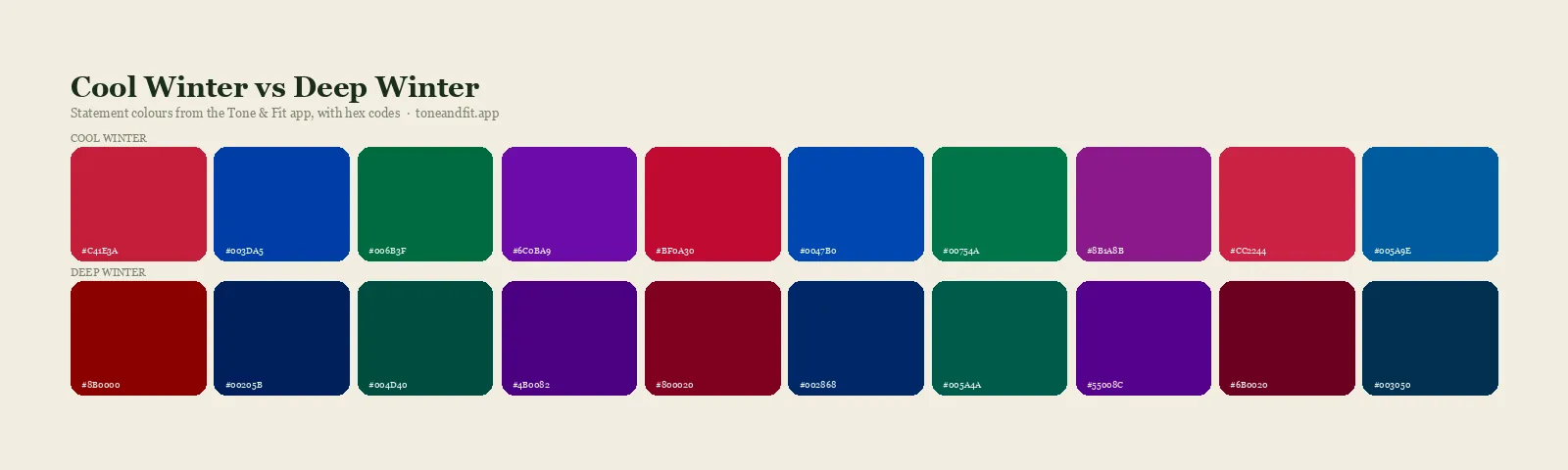
The two palettes overlap more than they differ, which is why so many people can wear both reasonably well and still feel that nothing is quite right. The overlap is the middle: true navy, pine green, deep plum, charcoal, burgundy, and clear cool red appear in both.
Cool winter owns the light cool end. Icy pink, icy lavender, icy blue, cool grey, raspberry, clear fuchsia, and optic white. This is the part of the palette a deep winter cannot use, because those colors need a lighter overall value to sit against. The full set is in the cool winter color palette, and the colors to keep out of are in cool winter colors to avoid.
Deep winter owns the deepest end, plus a narrow warm allowance. True black, espresso, deep forest, dark teal, and aubergine. The warm allowance is small and it only applies at depth: a deep winter can wear espresso but not camel, and dark olive but not mustard. You can see how the whole winter family relates on the winter palette page.
One practical consequence. If you are shopping and you keep buying the deepest version of every color available, you are behaving like a deep winter regardless of what a quiz told you. Wardrobe evidence you have already collected is often more reliable than a single test run in the wrong light, which is the argument made in how to read your color analysis results.
What each one looks like on a person
Cool winter
Skin that reads clearly cool, from porcelain through to deep with a blue or neutral cool base. Hair from medium brown through to black, usually with an ash, blue, or plum cast in daylight. Eyes that hold their color at a distance: clear blue, cool grey, green grey, or a cool medium brown, generally with a bright white sclera and a visible ring around the iris.
The tell is that at least one feature is not maximally dark. There is a genuine light note somewhere, and that note is what keeps the total value at medium to deep. The full profile is in am I a cool winter.
Deep winter
Hair that is dark brown to black, and it stays dark outdoors rather than revealing lighter strands. Eyes that are dark brown, near black, or a very deep cool green, often dark enough that the pupil is hard to find in ordinary light. Skin anywhere from fair to deep, cool or cool neutral in base.
The tell is that everything reads dark together. If a stranger describes your coloring, the word they reach for is dark rather than striking or icy. The full profile is in am I a deep winter.
Settle it in 60 seconds
Tone & Fit reads undertone, value, and chroma from one selfie and returns the season plus the palette, which is exactly the three numbers this question turns on.
Get your color season freeWhat goes wrong on the wrong side
Because the two palettes overlap in the middle, the wrong choice here does not look like a disaster. It looks like a wardrobe that is fine and never better than fine, which is harder to diagnose and easier to live with for years.
- A cool winter dressed as a deep winter gets heavy. Espresso and olive push yellow into the skin, black without any icy accent nearby looks flat rather than sharp, and the whole effect ages the face slightly. The usual complaint is that you look severe in photos rather than striking.
- A deep winter dressed as a cool winter gets washed. Icy pastels sit too light against very dark hair, the color reads as an absence rather than a color, and the eye goes to the hair instead of the face. The usual complaint is that pale colors make you look tired even in cool shades.
- Both end up with a wardrobe of navy and black that works well enough that the problem never becomes obvious, and a drawer of unworn experiments that does not.
If either pattern sounds familiar, colors that wash you out is a quick way to identify which of the two you are living in. Once you have decided, the follow on questions are covered in cool winter hair color and the cool winter makeup guide, both of which change meaningfully depending on which side you land on.
If you land on the boundary
Some people genuinely sit between these two, and that is a real position rather than a failed test. Cool winter and deep winter are adjacent, so the boundary is populated.
If your tests split, build the layer of your wardrobe that sits near your face out of the colors both palettes contain:
- True navy, which is the safest single color in this entire pair
- Pine or deep forest green
- Deep plum and aubergine
- Charcoal rather than either black or light grey
- Clear burgundy, kept away from both the brown and the pink extremes
- Cool red at full clarity
Then lean one direction with scarves, accessories, and outerwear, which are cheap to change if the lean turns out to be wrong. Both seasons take silver and white gold, so metals will not fight you either way, and the reasoning behind that is in gold or silver jewelry by undertone. The wider logic of building outward from a core is in the personal color analysis guide.
How to settle it
Three routes, in increasing order of effort.
- The wardrobe audit. Free, and it uses evidence you already have. Pull the six cool toned tops you own in the widest range of depths, from icy through to near black. Sort them by how often you actually wear them. If the top of the list is the deepest end, you are a deep winter. If icy and clear colors are in the top three, you are a cool winter. Six items chosen over years beats one swatch held up once.
- A photo analysis. Sixty seconds, and it returns the three underlying readings rather than only a season name, which matters here, because your uncertainty is specifically about value rather than temperature. Our free AI color analysis does this from a single selfie, and every route is compared against the others in find my color season.
- A draping session. The most thorough and by a distance the most expensive. Worth it if you have run everything above and still cannot separate the two.
Whichever route you take, check the input before you doubt the output. Warm indoor bulbs shift apparent skin temperature and beauty filters flatten value, and value is exactly the reading this question depends on. If your first result came from an evening selfie under a lamp, retake it in daylight before you treat it as a real answer.
And if the tests keep pointing outside the winter family altogether, the neighbours are worth checking. Cool summer sits directly next to cool winter and the two split on chroma rather than temperature, which is covered in cool winter versus cool summer. Deep autumn sits directly next to deep winter and the two split on temperature, which is covered in deep autumn versus deep winter. If you are not sure you are a winter at all, start further back with am I an autumn or a winter.
FAQ
What is the difference between a cool winter and a deep winter?
Two things separate them, and neither is coolness, because both seasons are cool. The first is value, meaning how deep your overall coloring is. Deep winter is the darkest season in the whole system, while cool winter sits at medium to deep. The second is temperature purity. Cool winter is fully cool and cannot tolerate any warmth at all, while deep winter is cool neutral and can carry a small amount of warmth in a deep color such as espresso or dark teal. So the practical question is not are you cool, it is are you dark enough to need the deepest palette, and does a warm deep color read as acceptable or as wrong on you.
Can both cool winter and deep winter wear black?
Yes, and this is exactly why the two get confused. Black is flattering on both, which makes it useless as a test. The useful colors are the ones only one of them can carry. Icy pastels such as icy pink, icy lavender, and icy blue belong to cool winter and tend to look thin and washed on a deep winter. Espresso brown, deep olive, and burnt aubergine belong to deep winter and tend to look muddy on a cool winter. Test with those, not with black.
Is deep winter darker than cool winter?
Yes, in overall coloring rather than in skin depth specifically. Value in color analysis is a combined reading of hair, eyes, and skin together, so a deep winter can have fair skin as long as the hair and eyes are very dark. A cool winter usually has one feature that is noticeably lighter or softer, most often the skin or the eyes, which keeps the total reading at medium to deep. If someone looks at a black and white photo of you and calls the picture almost entirely dark, you are on the deep side.
Which one am I if I have very dark hair and pale skin?
That combination is high contrast, and high contrast belongs to both of these seasons plus true winter, so it does not settle the question by itself. Check the eyes and the warmth tolerance instead. Very dark hair, pale cool skin, and clear blue or grey eyes with a white sclera usually reads cool winter. Very dark hair, pale skin, and near black or dark brown eyes usually reads deep winter, because the eyes push the total value down. Then confirm with espresso brown against the jaw.
What if the icy test and the espresso test both look fine?
That usually means you are at the boundary between the two, which is a real place to be rather than a failed test. Build the layer of your wardrobe that sits near your face from the colors both palettes contain, which are true navy, pine green, deep plum, charcoal, and clear burgundy. Then lean one direction with accessories, scarves, and metals, which are cheap to change if you decide you leaned the wrong way. Both seasons take silver and white gold, so jewelry will not fight you either way.
Does a cool winter suit warm colors at all?
No, and this is the sharpest line between the two. Cool winter is the more temperature strict of the pair. Camel, mustard, rust, warm coral, and orange based reds all push yellow into cool winter skin and produce a sallow, slightly unwell look. Deep winter can carry a small warm deep color such as espresso or a dark olive because its underlying reading is cool neutral rather than fully cool. If a warm deep neutral looks acceptable on you rather than actively wrong, that is a genuine signal toward deep winter.