How to Find Your Undertone With Gray Hair
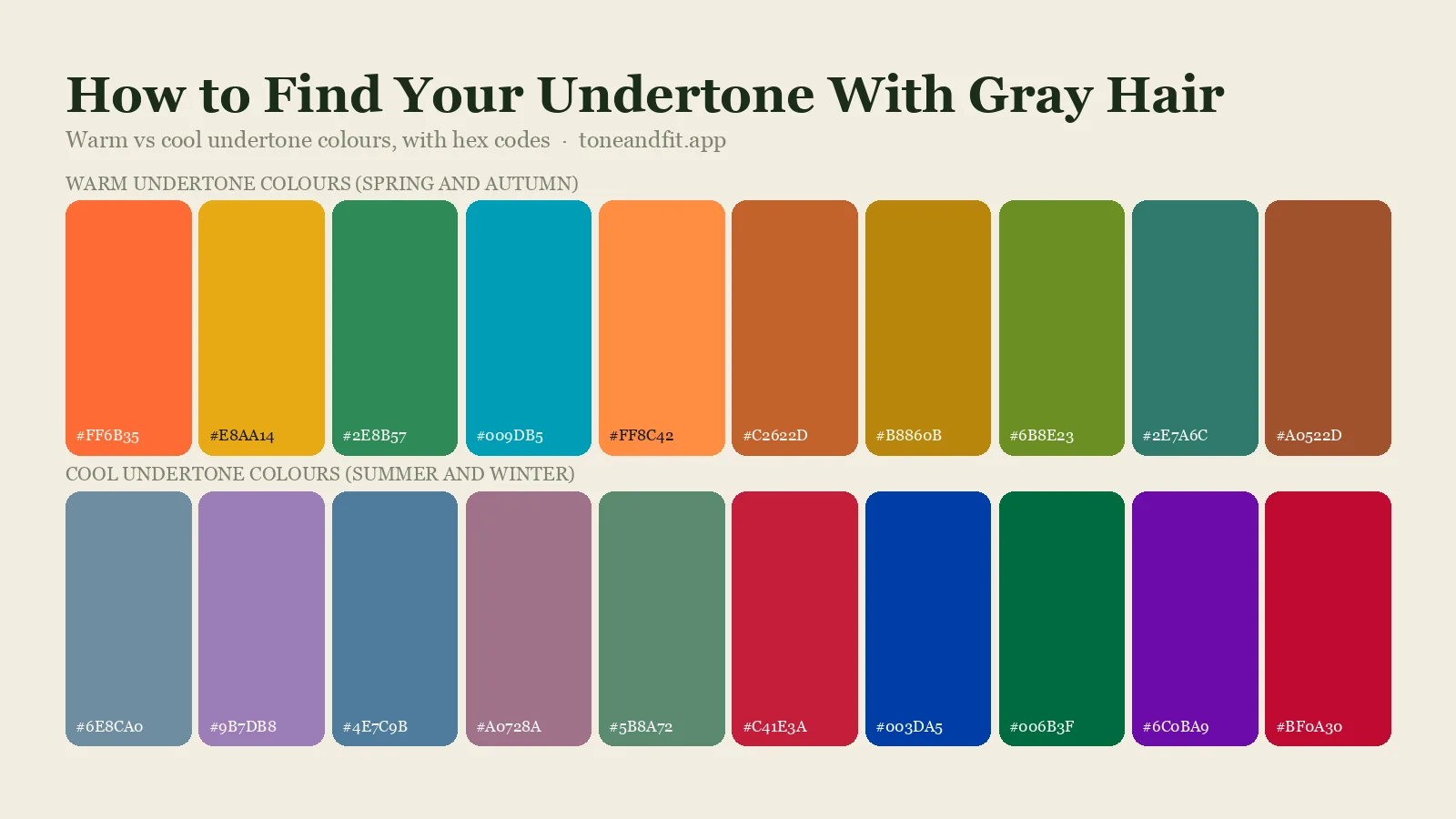
To find your undertone with gray hair, test your skin, not your hair. Hold gold and silver against your bare neck, compare stark white with cream under your chin, and check a daylight selfie with no makeup. Gray hair is cool and sits near your face, so it can make you read cooler than you are, which means you should judge the skin underneath rather than the frame around it.
The short version: your undertone does not change when your hair turns gray, but your best colors can shift a little. This post sits under our skin tone analyzer guide and gives you five tests, the traps gray hair creates, and how to adjust your palette.
What's in this guide
- The quick answer
- Why gray hair makes undertone harder to judge
- Does your undertone change as you go gray?
- Before you test: set up the conditions
- Five tests that work with gray hair
- Traps gray hair creates
- How to read mixed results
- Adjusting your palette for gray or silver hair
- If you are warm with gray hair
- If you are cool with gray hair
- If you are neutral or olive
- Which color seasons fit gray hair
- Common mistakes
- Checking your result with an app
- FAQ
The quick answer
Gray hair makes undertone trickier to read, but it does not make it impossible. Follow this order.
- Tie your hair back or cover it. Gray and white hair next to your face bounce light and push your skin toward cool in the mirror.
- Test in soft daylight. Stand by a window with no makeup, no filters and no colored light.
- Run at least three tests. Use the jewelry test, white versus cream and a bare-face selfie, then look for agreement.
- Judge the skin on your neck and chest. These areas are less affected by redness and sun than the face.
- Adjust, do not overhaul. Your undertone stays the same. Your palette may need a little more warmth or depth near the face.
The rest of this guide explains why each step matters, how to read tests that disagree, and what to wear once you know. If you are new to the idea, start with our guide on how to find your skin undertone at home.
Why gray hair makes undertone harder to judge
Undertone is the subtle tint beneath your skin, and it is judged by comparing your skin with colors held next to it. Gray and white hair are a strong color next to your face, and they are cool. They are close to neutral at best and blue-gray at worst. That brings two problems.
First, contrast changes. When your hair was dark brown or black, your skin looked light against it. Now that the hair is silver, the contrast is lower, and your skin can look warmer or sallower than before. Second, your eye is calibrated differently. A cool frame can make a warm complexion look golden and a neutral complexion look warm, so you may decide you are warmer than you are. Silver hair can also make a cool complexion look pinker.
The fix is not to ignore the hair but to take it out of the test. Pull it back, cover it with a white or neutral scarf, or test the skin on your neck and arms. Our post on going grey by color season covers how the hair itself fits into the bigger picture, and the guide to finding your color season after 50 is a helpful companion.
Does your undertone change as you go gray?
Your skin undertone is set by pigment and blood flow in the skin, and it does not switch from warm to cool just because your hair loses pigment. What does change as you age is the surface. Skin can thin, redness can increase, sun spots can appear, and the face can lose some of the golden glow it had when you were younger. These surface changes can make you look cooler or more sallow even though your base is the same.
So if you were told years ago that you are warm and you now doubt it, the answer is usually not that you changed. The more likely story is that the frame changed. The right response is to retest with the hair out of the picture, which is what the tests below do. You may also find that your best colors have moved a little. A shade that was perfect against dark hair may now be too heavy, and a softer version may look better. That is an adjustment within your undertone, not a new undertone.
Before you test: set up the conditions
The setup matters more than the test. Spend two minutes on it and every result gets more reliable.
- Light. Stand by a window in daylight, ideally on an overcast morning or with the sun behind a sheer curtain. Avoid yellow bulbs, which push everything warmer, and avoid bathroom lighting.
- Face. No makeup, no tinted moisturizer and no self-tanner. If you wear base makeup every day, wipe it off first.
- Hair. Pull it back, tuck it into a neutral wrap or cover it with a white towel. You want the face alone.
- Clothes. Wear a neutral top or drape a white towel over your shoulders so a colored shirt does not tint your skin.
- Camera. If you take a selfie, turn filters off, use the back camera if you can, and avoid flash. Our guide on why phone cameras misread skin tone explains the reasons.
Five tests that work with gray hair
1. The jewelry test
Hold a piece of gold jewelry and a piece of silver jewelry against your bare neck or the inside of your wrist, one at a time. If gold looks richer and silver looks harsh, you lean warm. If silver looks cleaner and gold looks brassy, you lean cool. If both look fine, you may be neutral or olive. Gray hair does not interfere with this test as long as it is pulled away from the face. See gold or silver jewelry for your undertone for how to run it with care.
2. White versus cream
Hold a sheet of stark white and a sheet of cream paper under your chin. If stark white looks fresh and cream makes you look yellow, you lean cool. If cream looks healthy and stark white looks harsh or gray, you lean warm. This test is especially useful with gray hair because the hair is already close to white. Compare notes with our post on white versus cream.
3. The bare-face daylight photo
Take a photo by a window with filters off, then look at it a few hours later. Look at the skin of your neck, jaw and cheeks away from any redness. A pink or blue-red base suggests cool. A yellow, golden or peachy base suggests warm. Neutral skin is a balanced mix. This works because a photo lets you step back from the mirror, which is helpful when gray hair fools your eye in person.
4. The color drape test
Hold two fabrics under your chin, one warm and one cool. A rust and a berry work well, or an olive and a navy. Whichever makes your skin look clearer, your eyes look brighter and the shadows under your eyes look lighter is the better family. For the technique in full, read how to do color draping at home.
5. The comparison to your old self
If you have old photos from your twenties or thirties taken in daylight, look at the skin on your arms and neck. Skin tone outside the face is a good clue to the base, because it does not carry the same redness or age changes. Compare how you looked in warm and cool colors then. This is a hint, not a test, but it can break a tie.
Traps gray hair creates
- The cool frame effect. Silver hair makes skin look warmer by contrast, so you may over-call warm.
- Lower contrast. With less contrast between hair and skin, bold colors can feel heavier than they used to. This is a contrast change, not an undertone change.
- Redness and sun spots. Age-related redness can make a neutral person look cool. Our post on finding undertone with redness explains how to look past it.
- Dye in the mix. If you color your hair, the shade you pick changes how the face reads. See how to find your color season with dyed hair.
- Old advice. A palette you chose in your thirties may be out of date because the hair around it is different.
See your own palette
The free web tool names your season from one selfie, with no sign-up. The app's scan is free too and shows your undertone, best metals and starter colors; your season and full palette in the app are an optional upgrade.
Find my season free → Get the app ↗How to read mixed results
If three or more tests agree, you have your answer. If they split, use this table to decide what to do next.
| What you see | Likely undertone | Next step |
|---|---|---|
| Gold, cream and warm drapes win | Warm | Explore warm seasons and read the warm undertone guide. |
| Silver, stark white and cool drapes win | Cool | Explore cool seasons, then retest in a second light. |
| Both metals work, both whites work | Neutral | Compare a soft season and a muted palette. |
| Gold works but cool drapes win | Olive or neutral | Test green-gold skin cast against deep teal and rust. |
| Results change by light | Unclear | Retest in daylight on a different day. |
If you land on neutral, our guides to neutral undertone and how to recognize neutral skin explain why the answer feels so slippery, and olive undertone covers the green-gold cast that often confuses tests.
Adjusting your palette for gray or silver hair
Once you know your undertone, the main adjustment for gray hair is contrast and temperature near the face. Silver hair is cool, so warm skin sometimes needs a touch more warmth in clothing, makeup and metals to avoid a washed-out look. Cool skin pairs easily with silver hair but may need more clarity in color so the whole look does not go flat. Depth also matters. A rich, deep color near gray hair creates a polished contrast, and a very soft color can blur everything together.
These are guidelines, not laws. Try one change at a time, such as a stronger lip color or a deeper scarf, and see how your face responds. For a bigger overview of how hair, skin and eyes combine, read the seasonal color analysis explainer.
If you are warm with gray hair
Warm undertones with gray hair look best when the clothing and makeup bring back some of the warmth the hair no longer provides. Camel, rust, warm teal, olive, terracotta, coral and cream are good choices. A warm lip color such as coral, peach or brick adds life to the face, and gold or rose gold jewelry can warm the area near the hair. Avoid wearing only icy, bluish shades, which can emphasize the gap between warm skin and cool hair.
Some warm people also like a soft golden or champagne tint in the hair to harmonize. That is a personal choice, and many warm people embrace silver with the right clothes. For palettes, see best colors for warm undertones and warm skin tones explained.
If you are cool with gray hair
Cool undertones and silver hair are naturally harmonious. Navy, emerald, sapphire, raspberry, plum, charcoal and true white all work, and silver or white gold jewelry looks clean. The risk for cool people is looking uniformly cool and soft, so add clarity with a strong lip, a vivid scarf or a deeper accent. Choose icy pastels only if your contrast is low, and use saturated cool colors if your contrast is high. See best colors for cool undertones for named shades and cool skin tones explained for the fundamentals.
If you are neutral or olive
Neutral and olive skin has the most flexibility and the most confusion with gray hair. The skin can look warm one minute and cool the next depending on the frame. The reliable approach is to favor colors in the middle of the range: dusty rose, soft teal, plum, warm taupe, muted emerald and blue-gray. Avoid the extremes of icy pastel and neon. For olive, deep teal, forest green and burgundy are safe starting points, and our page on color analysis for olive skin gives more.
Which color seasons fit gray hair
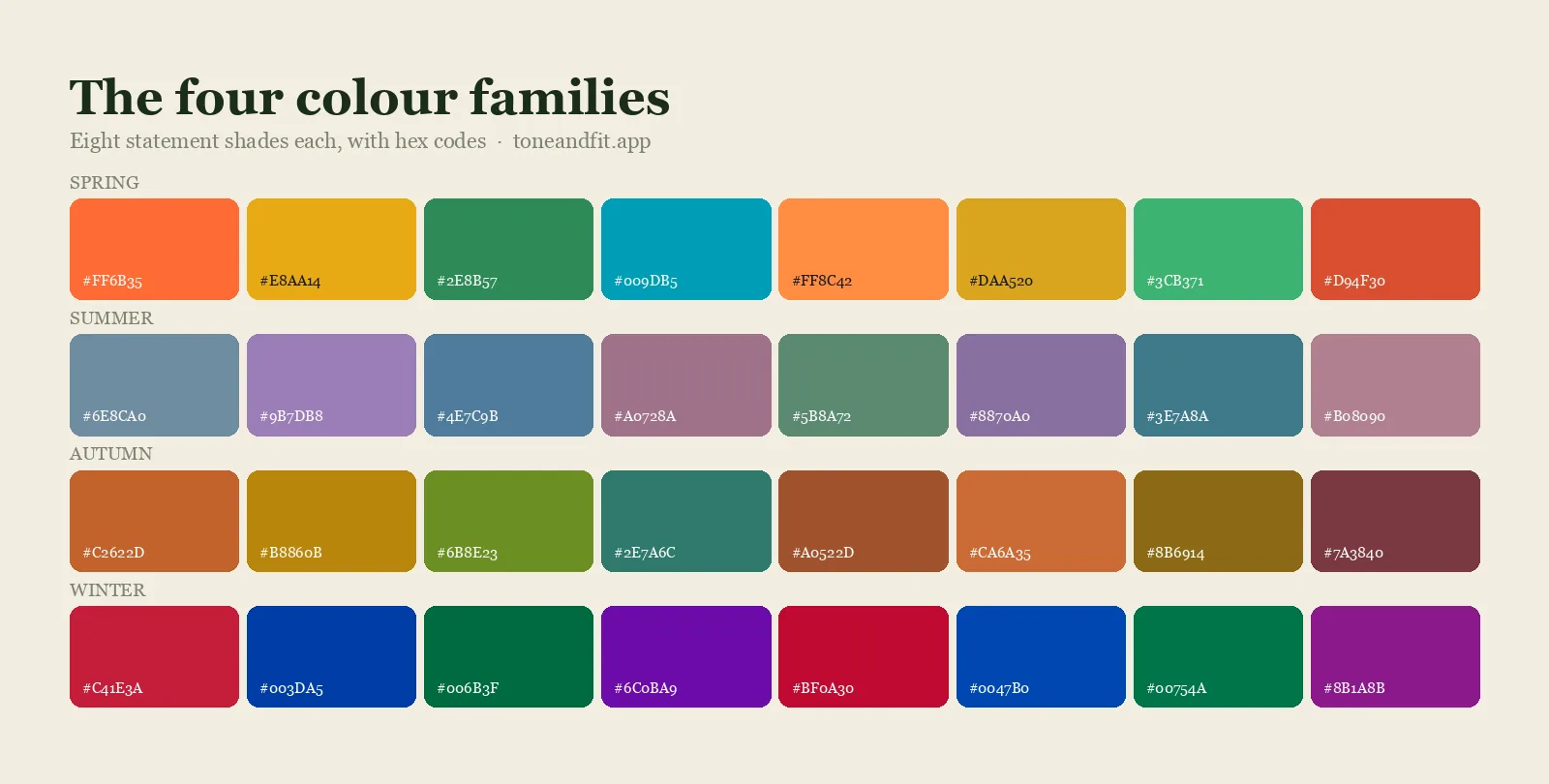
Gray hair appears in every season, and it does not decide your season. It does shape which palette feels easiest. Soft seasons such as soft summer and soft autumn blend easily with silver hair because the contrast is low and the colors are muted. Cool seasons such as cool winter pair well with white or silver hair because the clear, cool colors echo it. Warm seasons such as warm autumn can look wonderful with silver hair, but they often benefit from richer clothing to avoid a washed-out effect.
The overview of the 12 color seasons compares all of them. The find my color season guide gives a step-by-step route, and the personal color analysis guide covers the full method.
Common mistakes
- Testing with the hair loose. Silver hair near the face tints every result. Pull it back first.
- Deciding you are cool because your hair is. Hair color and skin undertone are separate. Judge the skin.
- Relying on one test. Use at least three and look for agreement.
- Testing under indoor light. Yellow bulbs push everything warm. Use daylight.
- Chasing an old palette. If your hair has changed, retest instead of assuming nothing has changed. More traps are listed in common color analysis mistakes.
Checking your result with an app
If you want an outside check, the Tone & Fit app reads skin, hair and eyes from a selfie and returns a season with a palette of named shades. Take the photo in soft daylight with filters off, and compare the result with your manual tests. If the two disagree, trust the one taken in better light. Our color analysis app guide explains what these tools measure and where they have limits, and the comparison of the best color analysis apps lists the options.
Skip the guesswork
The free web tool names your season from one selfie, with no sign-up. The app's scan is free too and shows your undertone, best metals and starter colors; your season and full palette in the app are an optional upgrade.
Find my season free → Get the app ↗FAQ
Does gray hair change your skin undertone?
No. Undertone comes from pigment and blood flow in the skin, not the hair. Gray hair changes the frame around your face, which can make you look cooler or warmer than you are, so test the skin with the hair pulled back.
How do I find my undertone if I have white hair?
Pull the hair back, stand by a window with no makeup, and run the jewelry test, white versus cream and a bare-face daylight photo. If at least three tests agree, you have your answer.
Can gray hair make me look cool when I am warm?
Yes. Silver hair is a cool frame, so it can make warm skin look more golden by contrast or make you doubt your own tests. Judge the neck and chest rather than the hairline.
Should I change my color palette when my hair turns gray?
Usually you adjust rather than replace it. Your undertone stays the same, but you may need slightly more depth or clarity near the face because the contrast with your hair is lower.
What colors look best with gray hair?
It depends on your undertone. Cool skin suits navy, emerald, plum and raspberry. Warm skin suits terracotta, teal, camel and coral. Neutral skin suits dusty rose, soft teal and taupe.
Is silver or gold better with gray hair?
Go by your skin. Cool skin usually looks cleanest in silver or white gold, warm skin in yellow gold, and neutral skin can wear both. Test both against your bare neck in daylight.
How accurate are undertone tests with gray hair?
They can be reliable if you remove the hair from the test and use several methods in daylight. A single test in a mirror is the least reliable, because the gray frame can bias your eye.
Can I check my color season from a photo?
Yes. The free Tone & Fit web tool reads your color season from one selfie in about 30 seconds, with no sign-up and no photo stored by us. The Tone & Fit app for iPhone and Android then builds your full palette of 38 named shades.