Best Colors for Warm Undertones
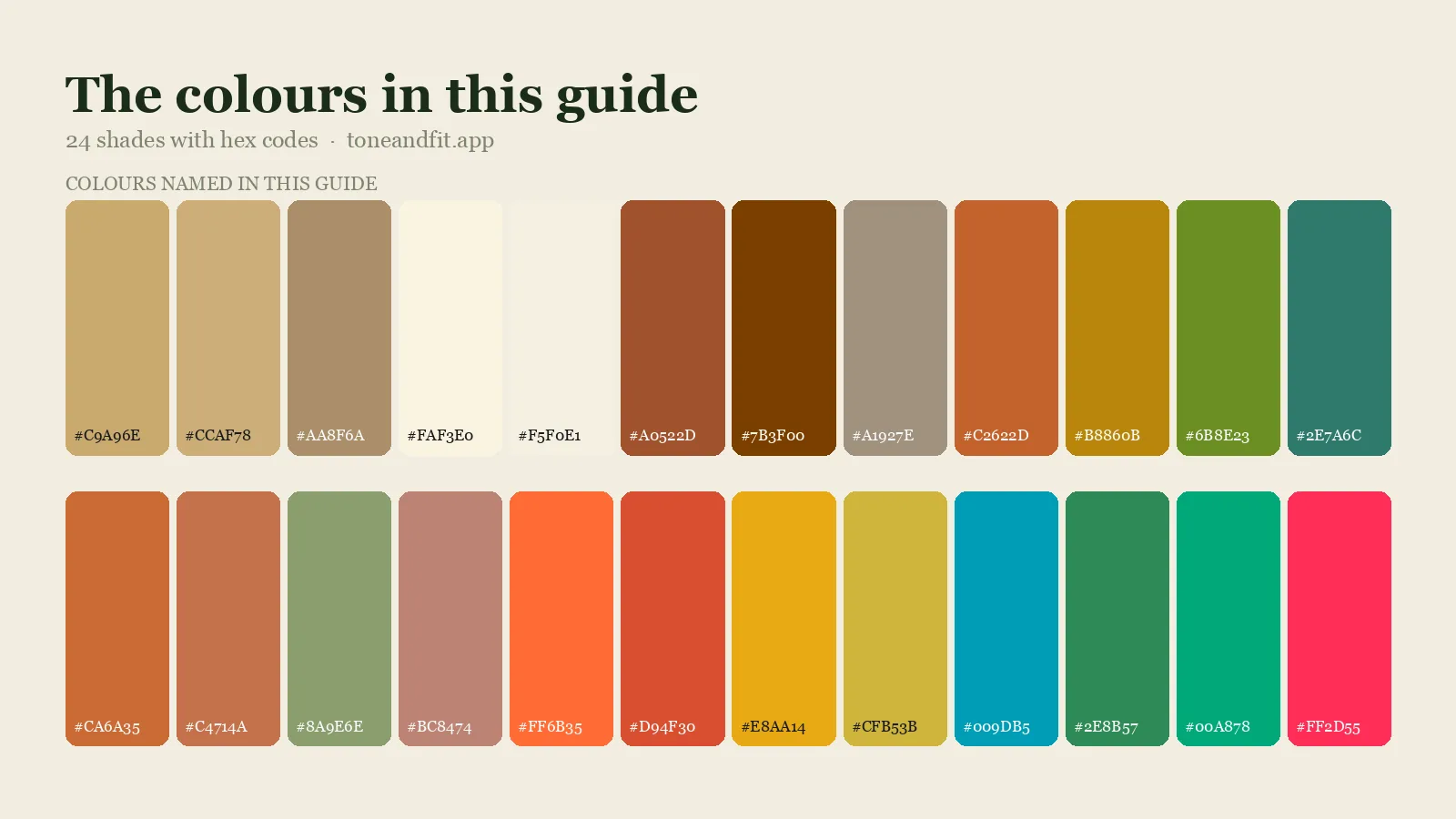
The best colors for warm undertones are camel, rust, olive, coral, warm teal, cream, chocolate brown and gold. Every one of them carries yellow, orange or green in its base, which is why a warm complexion looks even and rested in them instead of sallow, gray or flushed.
What's in this guide
What is a warm undertone, and how do you confirm it?
A warm undertone means the color beneath your skin's surface leans yellow, peach or golden rather than pink or blue, and you can confirm it with a few checks in daylight. Undertone is separate from how light or deep your skin is, so a warm undertone shows up on very fair skin, on tan skin and on deep brown skin alike. Our guide to warm versus cool skin undertone covers the full comparison. These are the quick checks.
- The paper test. Hold a sheet of pure white paper and a sheet of cream paper beside your bare face. If cream makes your skin look healthy and white makes it look pale or gray, you lean warm.
- The wrist test. In natural light, warm undertones often show greenish veins. Blue or purple veins point cool, and a mix of both points neutral. Veins are the least reliable of these checks, so treat the result as a clue and not a verdict.
- The jewelry test. Gold usually looks richer than silver against warm skin, which can make silver look slightly cold or flat.
- The sun test. Warm undertones often tan toward golden or bronze, where cool undertones more often turn pink first. Many people sit between the two, so it is a hint rather than proof.
If your results split, you may be neutral, or you may be a soft warm. Our walkthrough on how to find your skin undertone at home covers the ambiguous cases, and the last section below shows the fastest way to settle it.
Which colors look best on warm undertones, by group?
The best colors for warm undertones fall into four groups: golden neutrals such as camel and cream, clear brights such as coral and warm turquoise, soft pastels such as peach and butter, and rich darks such as chocolate brown and dark olive. Every swatch below is copied with its hex code from the Warm Autumn, Soft Autumn, Deep Autumn, Light Spring, Warm Spring and Bright Spring palettes, so you can paste the codes into a shopping filter or a notes app.
Neutrals for warm undertones
The best neutrals for warm undertones are camel, honey beige, toffee, cream and warm brown, not stark white, gray or pure black. These shades echo the gold in your skin, so a coat, trouser or bag in one of them looks like part of you. If you only buy one new piece, make it a camel or chocolate layer near your face.
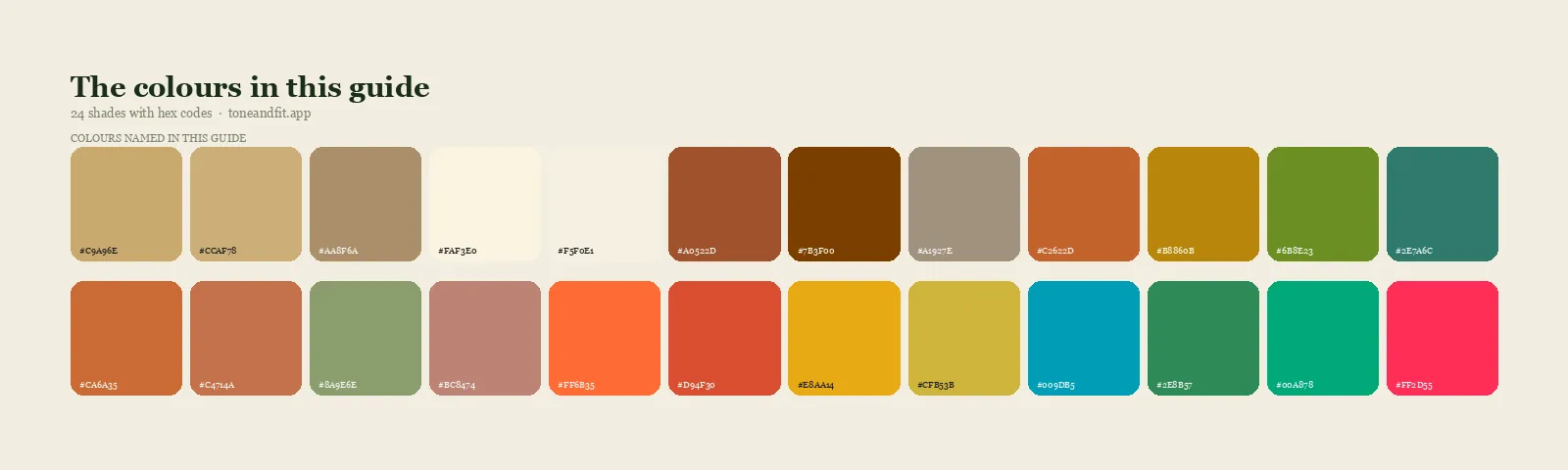
- Camel#C9A96E
- Honey Beige#CCAF78
- Toffee#AA8F6A
- Cream#FAF3E0
- Warm Ivory#F5F0E1
- Warm Brown#A0522D
- Chocolate Brown#7B3F00
- Walnut Taupe#A1927E
Earth tones: rust, olive, mustard and teal
Rust, olive green, golden mustard and warm teal are the signature earth tones for warm undertones, and they are the shades most people picture when they hear "autumn colors." They sit at a medium depth with a yellow or orange base, so they add richness without overpowering a warm face. Warm teal is the cool-looking color that works, because its green leans yellow.
- Rust Orange#C2622D
- Golden Mustard#B8860B
- Olive Green#6B8E23
- Warm Muted Teal#2E7A6C
- Pumpkin Orange#CA6A35
- Terracotta#C4714A
- Warm Sage#8A9E6E
- Dusty Warm Rose#BC8474
Brights: coral, golden yellow and warm turquoise
Warm brights are coral, golden yellow, warm turquoise and a green with yellow in it, and they suit warm undertones that also have clear, high-contrast coloring. The test is the undertone of the bright: a coral that leans orange is warm, while a pink-red that leans blue is not. Warm turquoise is the surprise on this list, and it flatters a golden complexion because it contrasts with orange rather than competing with it.
- Vivid Coral Orange#FF6B35
- Deep Warm Coral#D94F30
- Golden Yellow#E8AA14
- Warm Gold#CFB53B
- Warm Turquoise#009DB5
- Warm Medium Green#2E8B57
- Vivid Warm Teal#00A878
- Vivid Warm Pink Red#FF2D55
Pastels that work for warm undertones
Warm undertones can wear pastels as long as the pastel has peach, butter or cream in it, because the icy versions are the ones that fail. Think pale peach, soft butter yellow, mint with a hint of yellow, and light coral, instead of baby blue or lavender. Softer, grayed shades such as muted sage and warm cream are the easier choice if you also have low contrast.
- Pale Peach#FDD9B5
- Warm Peach#FFCA99
- Light Coral#FF9A76
- Pale Butter#FFF0C0
- Soft Mint#C9E4CA
- Pale Aqua#B5DEDD
- Muted Sage Green#A8B890
- Warm Cream#D8C8A0
Darks: chocolate, olive and bronze
The best dark colors for warm undertones are chocolate brown, dark olive, deep forest green, deep burgundy with brown in it, and bronze, and they replace black in a warm wardrobe. Black can overpower a warm face and cast a gray shadow under the eyes, while a deep brown or olive gives the same depth with warmth. Colors in this group are strongest on deep or medium warm complexions, and a good fit for winter coats and evening wear.
- Chocolate Brown#7B3F00
- Saddle Brown#8B4513
- Dark Olive#4A5D23
- Deep Forest Green#3A5838
- Deep Warm Burgundy#882020
- Deep Rust Red#7A3830
- Dark Bronze#6B5C28
- Deep Gold#8B6914
Want a starter capsule? Pick one shade from each group, for example camel, rust, warm teal, peach and chocolate. They all share a warm base, so they mix in any order. Our guide to a capsule wardrobe built around your color season shows how to scale that up, and the full shade library has a page for every named color with the hex code and styling notes.
See your own warm palette
One selfie and Tone & Fit places you in a season and returns the shades matched to your coloring, not warm skin in general.
Analyze my photo free ↗Which colors should warm undertones avoid?
Warm undertones should avoid icy pastels, blue-based pinks, cool magenta, steel blue, stark white and pure black, because all of them sit on the blue side of the color wheel and drain a warm face. Against golden skin those shades read as gray, and they can make the skin around your mouth and eyes look tired.
- Icy Pastel#E0FFFF
- Powder Pink#F8C8DC
- Lavender Pastel#E6E6FA
- Icy Blue-Grey#B0C4DE
- Cool Magenta#C71585
- Steel Blue#4682B4
- Stark White#FFFFFF
- Pure Black#000000
These are the swatches the Warm Autumn, Deep Autumn and Warm Spring palettes list as shades to skip, and each one has an easy warm swap:
- Icy pastels and baby pink: swap in peach, apricot or warm cream.
- Cool magenta and steel blue: swap in coral and warm teal.
- Stark white: swap in ivory, cream or oat.
- Pure black: swap in chocolate, dark olive or deep forest green.
These are guidelines, not laws. A cold color worn away from your face, such as trousers or shoes, matters far less than a scarf or collar. For a longer list of the shades that fight your coloring, read the colors that wash you out.
How do the warm color seasons differ?
The warm color seasons differ in lightness, clarity and depth: Light Spring is light and delicate, Warm Spring is golden and clear, Bright Spring is the most vivid, Soft Autumn is muted, Warm Autumn is rich and earthy, and Deep Autumn is dark and warm. In the 12-season system, warm undertones fall into the Spring family or the Autumn family, so one list of "warm colors" is only the starting point.
| Season | What sets it apart | Signature shades | Best neutral |
|---|---|---|---|
| Light Spring | Lightest and most delicate warm season | Light Coral, Pale Butter, Soft Mint | Cream |
| Warm Spring | Golden and clear, medium brightness | Vivid Coral Orange, Golden Yellow, Warm Turquoise | Camel |
| Bright Spring | The clearest, highest contrast of the warm seasons | Vivid Orange, Vivid Warm Teal, Vivid Yellow | Soft White |
| Soft Autumn | Muted and low contrast, warm but softened | Terracotta, Warm Sage, Dusty Warm Rose | Oat Cream |
| Warm Autumn | Rich, earthy and the warmest of all | Rust Orange, Golden Mustard, Olive Green | Camel Beige |
| Deep Autumn | The darkest and most intense warm season | Chocolate Brown, Dark Olive, Deep Warm Burgundy | Toast |
Read the table as a decision tree. If your coloring is light and fresh, look at the Springs. If it is muted and gentle, Soft Autumn. If it is dark and rich, Deep Autumn. The 12 color seasons guide walks through the tells for each.
What makeup and hair colors suit a warm undertone?
Warm undertones suit peach, coral, terracotta and brick on lips and cheeks, bronze, copper and olive on eyes, and hair in golden brown, honey, copper or chestnut. The rule is the same as for clothes: pick the version of a color with yellow or orange in it, not blue.
- Lips: coral, peach, warm nude, brick and a brown-leaning red. Skip blue-red and cool berry.
- Blush: peach, apricot and warm terracotta. Cool rose can look chalky.
- Eyes: bronze, copper, olive, warm brown and gold. Chocolate liner is softer than black.
- Hair: golden brown, honey, caramel, copper and chestnut. Ashy, blue-toned shades tend to fight a golden complexion.
Our guides to the best lipstick color for your undertone and the best hair color for your skin tone go shade by shade.
Does gold or silver look better on a warm undertone?
Gold looks better on most warm undertones, especially yellow gold, rose gold, brass, bronze and copper, while bright polished silver tends to look cold next to warm skin. The warmth in the metal repeats the warmth in your skin, so the jewelry looks like it belongs. Antique or brushed gold is often easier to wear than a high shine.
If you look just as good in silver, that is a sign you may be neutral, and our piece on gold or silver jewelry by skin undertone explains how to decide.
How can you check your own warm colors?
You can check your own warm colors by taking the free seasonal color quiz, then confirming the result with a selfie in the free color analysis tool. The quiz takes a couple of minutes and tells you whether you lean Spring or Autumn. The tool reads your coloring from one selfie, and your photo is analyzed, then discarded, never stored by us.
Take the selfie by a window in daylight, with no makeup and no colored light on your face. Then compare your result with the swatches above and browse the full color library for the shades you want to shop. If you want the overview first, start with what colors look good on me.
Find your exact warm season
Tone & Fit reads your undertone, depth and contrast from one photo and returns the palette that matches. Free, no sign-up.
Find my palette free ↗FAQ
What are the best colors for warm undertones?
Camel, rust, olive green, coral, warm teal, cream, chocolate brown and gold. All of them have yellow, orange or green in their base, which repeats the warmth in your skin and keeps your face looking even. Choose the version of any color that leans toward orange or yellow, not blue.
What colors look bad on warm undertones?
Icy pastels, blue-based pinks, cool magenta, steel blue, stark white and pure black. These sit on the blue side of the color wheel, so against golden skin they read as gray and tired. Each has a warm swap: peach for icy pink, coral for cool magenta, cream for white and chocolate for black.
Can a warm undertone wear black and white?
Sometimes, but cream and chocolate are usually better. Stark white and pure black can wash out a warm face, especially near the neck and chin. Ivory, cream, oat, dark brown, dark olive and deep forest green give the same crispness or depth with warmth. Deep warm complexions can often wear black well.
Is gold or silver better for warm undertones?
Gold is better for most warm undertones, especially yellow gold, rose gold, brass and bronze. The warmth in the metal matches your skin. Bright polished silver tends to look cold, although a soft, brushed silver can work on a warm-neutral complexion.
What is the best pink for a warm undertone?
Coral pink, peach, salmon and warm rose are the best pinks for a warm undertone. Pinks with orange or peach in them blend with golden skin, while blue-based pinks and mauve pull it toward gray. If a pink looks slightly orange in the bottle, it will probably suit you.
Can I check my color season from a photo?
Yes. The free Tone & Fit web tool reads your color season from one selfie in about 30 seconds, with no sign-up and no photo stored by us. The Tone & Fit app for iPhone and Android then builds your full palette of 38 named shades.