Best Scarf Colors for Your Skin Tone and Undertone
What's in this guide
- Why your scarf color matters more than your coat color
- The quick list: best scarf colors by undertone
- Best scarf colors for warm undertones
- Best scarf colors for cool undertones
- Neutral and olive undertones
- Scarf colors by skin depth and contrast
- Best scarf colors for all 12 color seasons
- How to use a scarf to rescue a coat in the wrong color
- Fabric, sheen and pattern change the color
- Black, grey, camel or cream: choosing a neutral scarf
- How to test a scarf color in 30 seconds
- Common scarf color mistakes
- A three scarf wardrobe that covers the whole winter
- Quick recap
- FAQ
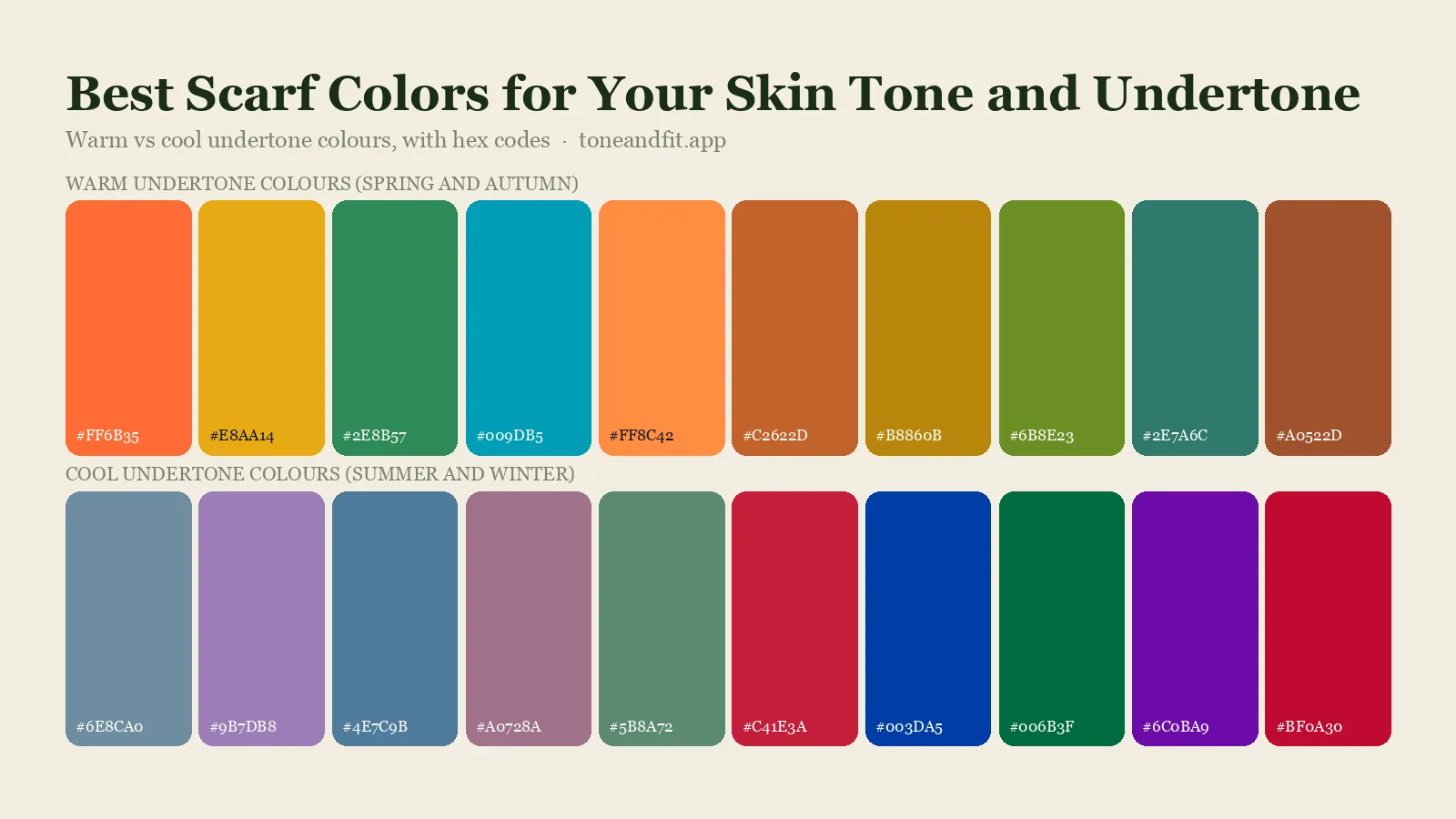
The best scarf color is the one that matches your undertone, because a scarf sits closer to your face than anything else you wear. Warm skin looks best in camel, rust, olive, mustard and cream. Cool skin looks best in charcoal, navy, berry, icy blue and soft white. Neutral and olive skin do best in muted middle shades such as teal, dusty rose, sage and soft burgundy.
That is the short answer. The rest of this guide gives you the long one: exact shade families by undertone, by skin depth and by all 12 color seasons, plus the trick that makes a scarf the cheapest fix for a coat or sweater in the wrong color. It is part of our wider guide to working out which colors look good on you, and it follows the same logic: get the color next to your face right, and the rest of the outfit has far more freedom.
Why your scarf color matters more than your coat color
Color analysis is really about one small area: the few inches of fabric directly under your chin. Light bounces off whatever sits there and lands on your jaw, your lips and the skin under your eyes. A flattering color evens your skin out and makes your eyes look clearer. An unflattering one throws a cast onto your face, which is why some colors make you look tired even when you slept well. Our guide to colors that wash you out explains that effect in detail.
A scarf is the only piece of clothing designed to live in exactly that zone. It wraps the neck, it often touches the jawline, and in cold weather it can cover everything from collarbone to chin. That makes it the highest impact item per square inch in your wardrobe. It also makes it the most useful one:
- It is the cheapest way to test a color. A scarf costs far less than a coat, so it is a low risk way to try a shade from your palette before you commit to it in something bigger.
- It overrides what is underneath. A scarf in your color placed over a coat that is not in your color changes what your face is reacting to.
- It is visible in every winter photo. From late autumn to early spring, your scarf is often the only color near your face that anyone sees.
So if you are going to be careful about the color of one cold weather item, make it this one. A coat color chosen for your skin tone is worth getting right too, but a coat is usually worn open or sits lower on the chest. The scarf wins on proximity.
The quick list: best scarf colors by undertone
Undertone is the warm, cool or neutral cast underneath your surface skin color, and it does not change with a tan or with the seasons. If you do not know yours yet, start with the four at-home undertone tests and then come back to this table.
| Undertone | Best scarf colors | Best scarf neutrals | Usually harder to wear |
|---|---|---|---|
| Warm | Rust, mustard, olive, terracotta, warm red, teal, forest green | Camel, cream, chocolate brown, warm beige | Icy pastels, blue-based pink, stark white, cool grey |
| Cool | Berry, plum, emerald, cobalt, icy blue, raspberry, blue-based red | Charcoal, navy, soft white, true grey | Mustard, orange, rust, yellow-based beige |
| Neutral | Teal, dusty rose, soft burgundy, jade, muted navy, mauve | Taupe, soft white, greige, mid grey | The most extreme warm or cool shades, such as neon orange or icy lilac |
| Olive | Deep teal, burgundy, sage, forest green, aubergine, petrol blue | Camel, taupe, warm cream, chocolate | Powdery pastels, cool mid grey, bright orange |
Treat the last column as "test first" and not as a ban. Depth, contrast and fabric all move the answer, and the sections below show how.
Best scarf colors for warm undertones
Warm skin has a golden, peachy or yellow cast, and gold jewelry usually flatters it more than silver. The scarf colors that work are the ones that carry some yellow in them too, because they agree with the skin instead of arguing with it.
Start with camel. It is the classic warm neutral for a reason: it echoes the gold in warm skin and goes with almost every coat color. Cream and ivory do the same job at the light end, and chocolate brown does it at the dark end.
Then add an earth tone. Rust, terracotta, mustard, burnt orange and olive are the signature warm scarf shades. If your coloring is light and fresh, choose the clearer versions, such as coral, warm peach and light golden yellow. If it is deeper and richer, go for the spiced versions, such as cinnamon, burnt sienna and bronze.
For blue and green, lean toward yellow. Teal, turquoise, moss and forest green are the warm friendly ends of those families. A royal or icy blue scarf tends to sit on top of warm skin like a separate object.
Our full list of the best colors for warm undertones covers every color family in the same way.
Best scarf colors for cool undertones
Cool skin has a pink, rosy or blue cast, and silver jewelry usually flatters it more than gold. Scarf colors with a blue base agree with that cast and make the skin look clear and even.
Start with charcoal or navy. These are the cool equivalents of camel: reliable, easy to pair, and kind to a cool complexion. Soft white and true grey work at the lighter end. A grey scarf is one of the hardest things for warm skin to wear and one of the easiest for cool skin, so use that advantage.
Then add a jewel tone or a berry. Emerald, sapphire, cobalt, plum, raspberry and burgundy with a blue base are the signature cool scarf shades. If your coloring is soft and light, choose the dusted versions, such as rose, lavender, powder blue and soft plum. If it is high contrast, go for the saturated versions, such as fuchsia, royal blue and true red.
For red, check the base. A cool red leans toward blue, like cherry or cranberry. A warm red leans toward orange, like tomato. The cherry scarf will make cool skin look bright, and the tomato one can make it look flushed.
There is a full breakdown in our guide to the best colors for cool undertones, and if your tests keep disagreeing, warm versus cool undertone explains which signals to trust.
Neutral and olive undertones
If both gold and silver look fine on you, you probably have a neutral undertone. You have the widest range of anyone, with one catch: the most extreme shades at either end tend to wear you. Your best scarves sit in the middle of the temperature scale and are slightly softened. Think teal, jade, dusty rose, mauve, soft burgundy and muted navy. For neutrals, taupe and greige were practically made for you.
Olive skin is a different case. It has a green or grey-green cast over a warm or neutral base, which is why standard advice often fails it. Powdery pastels can turn olive skin sallow, and a flat cool grey can make it look tired. Deep, slightly muted colors do the opposite: deep teal, burgundy, sage, forest green, aubergine and petrol blue all make olive skin look rich. See olive undertone explained to confirm whether this is you, and the best colors for olive skin for the complete list.
Scarf colors by skin depth and contrast
Undertone picks the temperature of your scarf. Depth and contrast pick how light, dark or strong it should be. Two people with the same cool undertone can need very different scarves if one is fair with dark hair and the other is deep skinned with dark hair.
| Your depth | Warm undertone | Cool undertone | Watch out for |
|---|---|---|---|
| Fair to light | Peach, light camel, warm ivory, soft coral, golden beige | Powder blue, soft rose, lavender, light grey, soft navy | Very dark, heavy scarves that leave your face looking smaller and paler than it is |
| Medium to tan | Rust, mustard, olive, terracotta, warm teal | Berry, emerald, cobalt, charcoal, plum | Shades close to your own skin color, which blur the line between scarf and face |
| Deep | Burnt orange, gold, warm red, bronze, rich cream | Fuchsia, royal blue, true white, emerald, deep purple | Dusty mid tones that go flat or ashy against rich skin |
Contrast is the second half of this. If there is a big difference between your hair, skin and eyes, you can carry a bold scarf or a strong pattern. If your features are close together in depth, a softer, blended scarf will look more like you. Our guide on how to find your contrast level shows how to measure it with one photo.
For more detail at each end of the range, see the best colors for pale skin and the best colors for dark skin tones.
Best scarf colors for all 12 color seasons
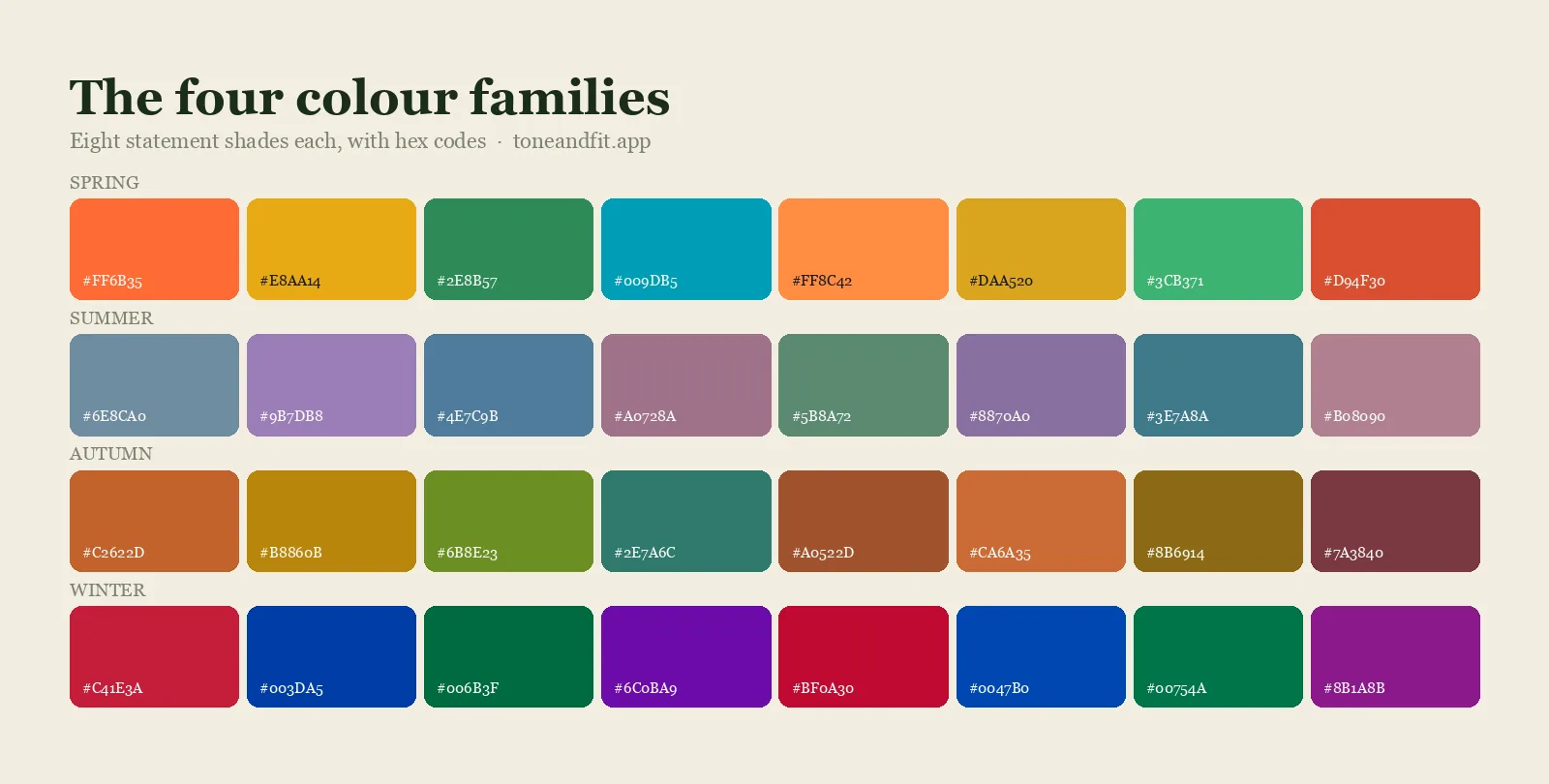
If you already know your season, you can skip the reasoning and go straight to the shortlist. Each row gives one neutral scarf to wear with everything, and two accent scarves that do the most for your face. If you do not know your season, the 12 color seasons guide walks through each one.
| Season | Everyday neutral scarf | Accent scarves |
|---|---|---|
| Light Spring | Warm ivory | Peach, light aqua |
| Warm Spring | Camel | Coral, golden yellow |
| Bright Spring | Warm navy | Hot coral, bright turquoise |
| Light Summer | Soft white | Powder blue, rose pink |
| Cool Summer | Blue-grey | Raspberry, soft teal |
| Soft Summer | Dove grey | Dusty rose, sage blue |
| Soft Autumn | Warm taupe | Sage, muted salmon |
| Warm Autumn | Camel | Rust, mustard |
| Deep Autumn | Chocolate brown | Burnt orange, forest green |
| Deep Winter | Black or charcoal | Burgundy, emerald |
| Cool Winter | Charcoal | Sapphire, icy pink |
| Bright Winter | True white | Fuchsia, electric blue |
Notice that the neutral changes as much as the accent does. A camel scarf on a Cool Winter is as far off as an icy pink one on a Warm Autumn. If you want to understand why the seasons divide this way, seasonal color analysis explained covers the three dimensions behind them, and every season has a full palette on the palettes hub.
See which colors belong next to your face
The free web tool names your season from one selfie, with no sign-up. The app's scan is free too and shows your undertone, best metals and starter colors; your season and full palette in the app are an optional upgrade.
Find my season free → Get the app ↗How to use a scarf to rescue a coat in the wrong color
This is the most practical thing a scarf can do. Most people own at least one coat or jacket that they love and that does not love them back. The usual example is a black coat on someone with warm, soft coloring, or a camel coat on someone cool.
You do not need to replace the coat. You need to change what is next to your face. Wear a scarf in one of your best colors high on the neck, so that it sits between the coat collar and your jaw. Your face now reflects the scarf, and the coat becomes a background color further down the body, where it matters much less.
A few details make the rescue work better:
- Wear it high and full. A thin strip of scarf tucked inside a collar does little. A full wrap or a chunky knot that covers the collar does a lot.
- Choose a light or bright shade against a dark coat. If black drains you, a cream, camel or rust scarf puts light back onto your face. Black next to the face suits cool, deep and high contrast coloring best, so everyone else benefits from breaking it up.
- Match the coat's formality, not its color. The scarf should suit your skin first. It only needs to look intentional with the coat.
- Use the same trick with knitwear. A sweater in a difficult color gets easier with a scarf in your palette at the neckline. See the best sweater colors for your skin tone for the knitwear version of this guide.
The trick works in reverse as well. If you want to wear a scarf in a color that is outside your palette, wear it lower and looser, over a top or coat in a shade that does suit you. How to wear colors outside your palette has more of these workarounds.
Fabric, sheen and pattern change the color
Two scarves dyed the same shade can look different on you, because fabric changes how color behaves.
- Matte wool and cashmere absorb light, so colors look softer and slightly deeper. This suits muted coloring well and makes strong colors easier to wear.
- Silk and satin reflect light, so colors look brighter and cooler at the highlights. This suits clear, high contrast coloring. On soft coloring a shiny bright scarf can take over the face.
- Chunky knits create shadows between the stitches, which darkens and mutes the overall color. A chunky cream scarf reads warmer and softer than a flat woven one.
- Brushed and fluffy textures blur a color's edge, which softens the contrast between scarf and skin.
Pattern follows a simple rule: judge it by its overall effect from a few steps back, and by the color that will sit closest to your face once it is tied. A plaid scarf that is mostly camel with a thin blue line reads as camel. A print with a white ground reads light and high contrast. If a patterned scarf contains one color that is wrong for you, fold or wrap it so that color ends up away from your jaw.
Pattern scale matters too. High contrast coloring can carry large, sharp patterns such as bold checks and stripes. Softer coloring looks better in blended patterns such as heathered weaves, watercolor prints and tone on tone designs.
Black, grey, camel or cream: choosing a neutral scarf
Most people buy a neutral scarf first, and most people buy the wrong one, usually black or mid grey because those look safe on the shelf.
| Neutral scarf | Works best on | If it does not suit you, try |
|---|---|---|
| Black | Cool or deep coloring with high contrast | Charcoal if you are cool, chocolate brown if you are warm |
| Grey | Cool and neutral-cool undertones | Taupe or greige, which add a little warmth |
| Camel | Warm and neutral-warm undertones | Taupe if you are soft and cool, charcoal if you are high contrast |
| Cream | Warm undertones at any depth | Soft white if you are cool, true white if you are high contrast and cool |
| Navy | Almost everyone, in the right version | Warm navy with a hint of teal if you are warm, deep ink navy if you are cool |
White and cream deserve a closer look, because they sit so near the face. Hold each one under your chin next to a sheet of plain white paper, and keep the one that makes your skin look clearer. Neutrals by color season lists the best three or four neutrals for every season, which is useful when you want one scarf to go with a whole winter wardrobe.
How to test a scarf color in 30 seconds
You can check any scarf before you buy it, and the test is the same one professionals use for draping.
- Go to daylight. Stand near a window or a shop door. Store lighting is usually warm and makes most colors look kinder than they are.
- Hold the scarf under your chin, touching your jawline, with your hair pulled back if it is dyed.
- Look at your face, not the scarf. Check three places: under your eyes, around your mouth and along your jaw. A good color makes shadows look lighter and skin look more even. A poor one deepens shadows or adds a yellow, grey or red cast.
- Compare two at once. Hold one scarf, then another, and switch back and forth. The difference is much easier to see in comparison than in isolation.
- Take a photo of each. A quick phone photo with no flash and no filter makes the better color obvious, and it removes the bias of liking the scarf itself.
If you want to run this properly at home with fabric or clothes you already own, follow how to do color draping at home. You can also keep your palette on your phone while you shop, which is what how to shop your color palette is about.
Common scarf color mistakes
- Matching the scarf to the coat. A matching scarf gives you a block of one color with no benefit for your face. Choose the scarf for your skin and let it contrast with the coat.
- Buying black by default. Black next to the face is demanding. If you are warm or soft, a black scarf is the single easiest winter item to improve on.
- Choosing by the color you like on the shelf. A color can be beautiful and still be wrong on you. Always judge it against your face.
- Ignoring your jewelry. Earrings and necklaces share the same zone. If gold suits you, a gold-friendly scarf color will too. Gold or silver for your undertone is a quick cross check.
- Going too close to your skin color. A beige scarf on beige skin erases the line between the two. Go clearly lighter, clearly darker or clearly more colorful.
- Forgetting that hair counts. A scarf sits against your hair as well as your skin. A rust scarf against red hair or a charcoal one against silver hair can look deliberate and striking.
A three scarf wardrobe that covers the whole winter
You do not need many. Three scarves, chosen well, cover nearly every outfit:
- One neutral from your palette. Camel, cream or chocolate if you are warm. Charcoal, navy or soft white if you are cool. Taupe or greige if you are neutral or olive.
- One signature color. The shade that gets you the most compliments. This is the scarf you wear with a plain coat when you want to look awake.
- One pattern that contains both. A plaid, stripe or print that combines your neutral with your signature color ties the three together and works with every coat you own.
If you are not sure what your signature color is, that is exactly the question a color analysis answers. The personal color analysis guide covers the full process, from undertone to a finished palette.
Quick recap
- A scarf sits closer to your face than any other garment, so its color matters more than the color of your coat.
- Warm undertones: camel, cream, rust, mustard, olive. Cool undertones: charcoal, navy, berry, emerald, icy blue. Neutral and olive: teal, dusty rose, sage, soft burgundy, taupe.
- Adjust for depth and contrast: lighter and softer for fair, low contrast coloring, and richer or brighter for deep or high contrast coloring.
- Use a scarf in your palette to rescue a coat or sweater in a color that does not suit you.
- Test every scarf under your chin in daylight, and compare two at a time.
Find your scarf colors in 30 seconds
The free web tool names your season from one selfie, with no sign-up. The app's scan is free too and shows your undertone, best metals and starter colors; your season and full palette in the app are an optional upgrade.
Find my season free → Get the app ↗FAQ
What color scarf goes with everything?
The scarf that goes with everything is a neutral from your own palette, and it is different for different people. Camel or cream works for warm undertones, charcoal or navy for cool undertones, and taupe or greige for neutral and olive skin. A neutral that suits your skin will look right with nearly any coat.
What color scarf should I wear with a black coat?
With a black coat, choose a scarf in one of your best face colors and wear it high on the neck. Cream, camel and rust warm up a black coat for warm skin, while berry, emerald, icy blue and soft white brighten it for cool skin. Avoid a black scarf unless black already suits you next to your face.
What scarf colors suit pale skin?
Pale skin with a cool undertone suits powder blue, soft rose, lavender, light grey and soft navy. Pale skin with a warm undertone suits peach, warm ivory, light camel and soft coral. Very dark, heavy scarves can overwhelm fair coloring unless you also have dark hair and high contrast.
What scarf colors look best on dark skin?
Dark skin looks best in rich or bright scarf colors with enough intensity to stand up to it. Burnt orange, gold, warm red and bronze flatter deep skin with a warm undertone, and fuchsia, royal blue, emerald and true white flatter deep skin with a cool undertone. Dusty mid tones tend to look flat.
Should my scarf match my coat?
No. Your scarf should suit your skin first and simply look intentional with your coat. A scarf that contrasts with the coat puts a flattering color next to your face, while a matching one just extends the coat color upward.
Is a grey scarf flattering?
A grey scarf is flattering on cool and neutral-cool undertones, where it works as an easy everyday neutral. On warm or olive skin, a cool mid grey can look flat and tiring, so taupe, greige or camel is usually the better choice.
Can a scarf fix a coat color that does not suit me?
Yes. Wear a scarf from your palette high and full at the neck, so it sits between the coat collar and your jaw. Your face then reflects the scarf instead of the coat, which makes the coat color matter far less.
Can I check my color season from a photo?
Yes. The free Tone & Fit web tool reads your color season from one selfie in about 30 seconds, with no sign-up and no photo stored by us. The Tone & Fit app for iPhone and Android then builds your full palette of 38 named shades.